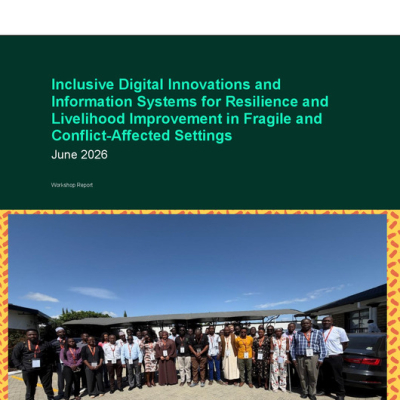
BioStruct-Africa’s scalable framework for AlphaFold-enabled research training and sustainable workforce development in Africa
Unique ID
894f5623-57f4-4eb9-824a-780dda391e17
Collections
Artificial intelligence is rapidly transforming structural biology and accelerating access to protein structures, yet many Africa-based scientists still lack infrastructure, training opportunities, and sustained mentorship to fully benefit. Here, we describe BioStruct-Africa’s community-driven framework integrating AlphaFold, experimental structural biology, and computational drug design to train 1000 scientists over the next decade.
External Authors
Amofa, Justice O.
Citation
Amofa, J.O., George, J., Okumu, N.A., Ohene, M., Terefe, E.M., Tsomene, S.L., Tougue, O.C., Bejide, I.O., Nabukeera, K.C., Nelson, A.Y., Tagne, C.S.D., Osabutey, P.Y., Ndiaye, A., Nkwe, D.O., Ohaekenyem, E.C., Jolaiya, T.F., Banda, H., Ikponmwosa-Eweka, O., David, W.N., Ekpenyong, B.B., Segda, A., Diabate, O., Jarso, A.H., Arafat, K., Elrashedy, A., Yadeta, M.M., Richard, Z.B., Omara, I.E., Ndaba, T., Ejiofor, I.I., Magwell, P.F.R., Sedeek, M., Lazaro, L.O., Nyoni, R.M., Oketch, R.A., Odur, W., Hassan, Y.M., Ambala, P., Chandipwisa, C., Bassey, O.P., Ondari, L.N., Jonah, U.G., Amoussou, C.A., Kyomukama, R.C., Yamssi, C., James, S.C., Kone, A.K., Ndiaye, O., Ssenfuka, H., Nyang'au, A.K., Amos, Y., Kawalya, H., Mware, B., Adundo, W.J., Ngannang-Fezeu, V.B., Tandja, A.G., Abdellatif, A.H., Omowumi, O.F., Luutu, N.M., Kouman, A.K.B., Soliman, D.S., Essilfie, N.K., Wabwile, J.J., Sankhe, S., Fofana, F.G., Heiba, W., Yao, N., Djikeng, A., Akurut, E., Walakira, A., Moumbock, A.F.A., Griese, J.J., Tiengwe, C., Ndi, M., Martin, I.S., Fodje, M., Rüffin, N.V., Cramer, K.C., Davis, J. and Nji, E., 2026. BioStruct-Africa’s scalable framework for AlphaFold-enabled research training and sustainable workforce development in Africa. Communications Biology 9:321.
Cover
Doi
https://doi.org/10.1038/s42003-026-09711-x
Handle
10568/181908
Link to journal
Permanent Link
Publication Type
Published on
2026-02-25
Publisher
Nature Research
Publication year
Access Rights
Open Access
Internal Authors
Published on