Accelerating the reach and utilization of validated feed and forage innovations: A multi-partner planning workshop
Abstract
Summary of presentations
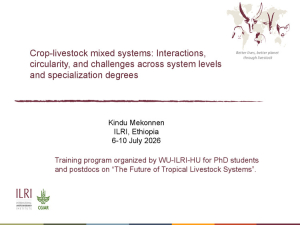
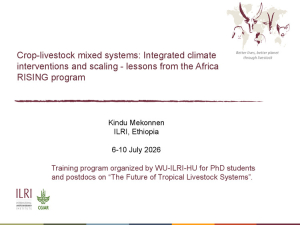
Research and scaling of livestock feed and forage innovations: An overview
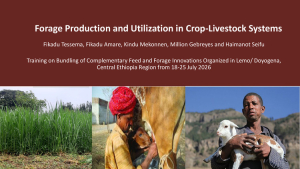
Over the past several years, ILRI and its partners have made significant progress in researching and scaling livestock feed and forage
innovations across Ethiopia, recognizing that bridging feed gaps through climate-smart solutions is essential for strengthening agri-food
systems. As presented by Dr. Kindu Mekonnen, Senior Scientist at ILRI, efforts before 2022 focused on evaluating the dry biomass and
nutritive value of various forage options suited to the Ethiopian highlands, including oats, vetch, lablab, alfalfa, and desho grass, among
others. Since 2022, this work has expanded through programs such as Sustainable Farming, Scaling for Impact, AICCRA, and TAAT Phase
II, with research now addressing frost-prone areas, cutting/frequencies of leguminous fodder –fertilizer trees and forages, home-garden
intensification, bundling of feed and forage innovations, multilocational forage adaption trials, intercropping of maize and forage options
in mazed based farming systems, forage seed multiplication, piloting of forage seed commercialization business models, deployment of
revolving forage seed supply systems, capacity sharing and media engagement to speed up wider scaling of validated feed and forage
innovations. Community radio programs broadcast in five local languages and mobile audio blasts enabled us to reach and benefit over
283,000 farmers, extension agents, and partners. Capacity-sharing efforts have been initiated to train over 6,000 farmers and extension
agents, supported by field days and collaborations with local broadcasters and development offices.
Key lessons learned from Dr. Kindu Mekonnen’s overview highlight the importance of offering a diverse menu of feed and forage options,
linking these to livestock enterprises and youth employment, and combining complementary innovations such as seed systems,
financing, and media for wider scaling. The work has also shown the need to think beyond subsistence models toward commercial forage
seed and biomass production, working through farmer organizations to reach more beneficiaries. Challenges remain, including limited
fundraising and a shortage of full-time staff members in the team. However, strong partnerships with government and non-government
actors, along with major government initiatives like Yelemat Turufat, Ethiopia Food Systems Resilience Project (EFSRP), Livestock and
Fisheries Sector Development Project (LFSDP), LLRP, and the upcoming MCF project on unlocking job opportunities in the feed sector,
create a viable pathway for sustaining and scaling this work.
Citation
Mekonnen, K., Gebreyes, M., Alene, T., Tessema, T., Seifu, H. and Mesfin, H. 2026. Accelerating the reach and utilization of validated feed and forage innovations: A multi-partner planning workshop. Nairobi, Kenya: ILRI