The Centre for Tropical Livestock Genetics and Health (CTLGH) supports programs that improve livestock-based livelihoods in the tropics. It is a strategic alliance of ILRI, the Roslin Institute at the University of Edinburgh, and Scotland’s Rural College.
The dairy genomics program
The dairy genomics program seeks to facilitate the application of genomics to dairy production in the tropics for increased livestock productivity, enhanced livelihoods of the rural poor, increased food and nutritional security, and more sustainable environmental development.
This will be achieved through the:
- identification of, and advocacy for, key applications of genomics to dairy production in the tropics;
- support for the development of tools and methodological approaches to facilitate the above identified applications;
- delivery of capacity building training; and
- establishment of research and resource mobilization partnerships.
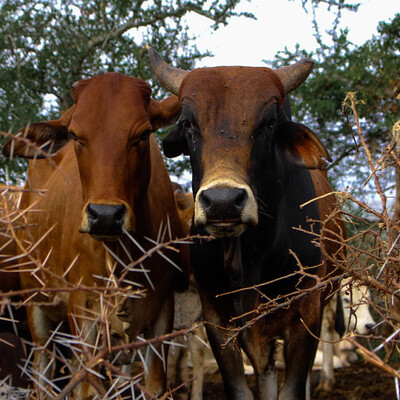
A collated set of sequence and genotype information on cattle breeds in Africa is currently not available. Such a resource is important as it can underpin the design of genomic tools for different applications. In collaboration with African partners, the dairy genomics program will facilitate the generation of this important resource by collating data already available in public databases and data with private research groups (where access is granted) and through the generation of new data.
A schema of the genomic reference resource is given below. It will comprise the genomic data on African cattle breeds, metadata on the sequenced or genotyped animals (such as their GPS location at time of sampling), as well as documented and easily searchable outputs arising from the use of the data (tools, publications, etc.).The entry point to this will be a website and data-portal, which captures metadata and allows for it to be easily searched, browsed, analysed and used. The raw genomic data will be archived in the major public sequence databases (NCBI and EMBL-EBI).
The initial target for the resource is 25 African cattle breeds with sequence information on at least 10 individual animals per breed by the end of 2017. The expectation is that the number of breeds and individual animals per breed will increase over time, as the initiative gains momentum and additional resources become available.
Intended use
It is intended that the resource be used by the African and international research community in cattle genomics for the ultimate benefit of African livestock keepers, other livestock value chain actors and animal-source food consumers. To this end, the dairy genomics program will also facilitate the capacity building of African researchers in the field of genomics.