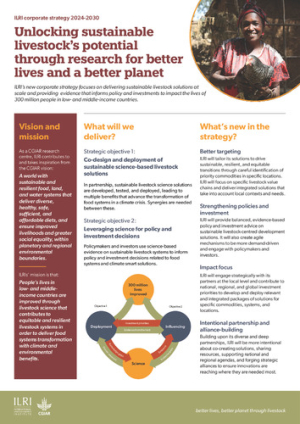
Co-developing a Kenyan scenario model towards a sustainable food system: Reflections from the Kenya Interactive Food Systems Model workshop
Abstract
Rising food prices, persistent nutritional inequities, climate volatility, recurrent food-safety incidents, and fragmented governance continue to undermine progress toward Kenya’s food and nutrition security goals. These pressures are amplified by rapid population growth and urbanization, widening disparities in access to diverse, healthy diets. Despite sustained investment in agricultural modernization and policy reform, systemic vulnerabilities remain evident: dietary gaps persist, market volatility constrains affordability, and climate shocks increasingly destabilize production and prices. Together, these dynamics highlight the need for integrated, forward-looking analytical tools that can connect dispersed evidence, make trade-offs explicit, and support decisions under uncertainty. The Kenya Interactive Food System Model (KeIFSM) responds to this need by providing a dynamic, participatory, and analytically rigorous platform for understanding how Kenya’s food system functions and how it may evolve under alternative policy, market, environmental, and behavioral scenarios. Codeveloped by the Sustainable Nutrition InitiativeR (SNi) and the International Livestock Research Institute (ILRI), KeIFSM integrates agriculture, nutrition, markets, environment, and trade within a single systems framework designed to help decision-makers visualize interdependencies, anticipate unintended consequences, and navigate competing objectives in food-system transformation. A co-development workshop held on 1 October 2025 at ILRI Headquarters in Nairobi convened more than 50 participants from national ministries, county governments, research institutions, civil society organizations, the private sector, and farmer groups. Using participatory systems-thinking methods visioning, trade-off elicitation, indicator identification, scenario co-creation, and barrier–enabler mapping participants generated a structured relational dataset comprising 162 vision statements, 43 trade-off statements, and 124 unique indicators, linked through matrices that capture how stakeholders connect aspirations to constraints and measurement priorities. Analysis shows a coherent national transformation logic centered on equitable access to healthy diets, with markets and affordability as the dominant pathway shaping diet outcomes. Connectivity patterns indicate that nutrition and markets are the most structurally embedded themes in stakeholder reasoning, linking strongly to both trade-offs and indicators. Stakeholders highlighted recurring tensions i.e. affordability versus nutrition quality, productivity versus environmental sustainability, and safety versus inclusion of informal markets implying that policy must manage trade-offs rather than assume simple win–win solutions. Scenario work identified eight priority domains of system change: climate extremes, price shocks, dietary transitions, agroecology shifts, food-safety crises, policy reforms, value-chain restructuring, and technology transitions, supported by feedback-loop logic through which shocks propagate across production, prices, diets, trust, and resilience. The report translates these insights into KeIFSM’s conceptual architecture: a transparent computation pipeline organized around population needs, land-based production activities, balancing mechanisms, trade and cashflows, and additional outcomes integrated through a core inventory table for consistent accounting of inputs and outputs. It recommends formal institutional anchoring, clear datagovernance and interoperability protocols, sustained financing for model maintenance, county-level capacity strengthening, and stronger mechanisms for embedding model outputs into planning and policy cycles so KeIFSM functions as a durable national public good.
Citation
Rojas, D.T., Karugia, J., Gicheha, S., Ojwang’, S. and Ahlborn, N. 2026. Co-developing a Kenyan scenario model towards a sustainable food system: Reflections from the Kenya Interactive Food Systems Model workshop. Nairobi, Kenya: ILRI.
Authors
Related Publications
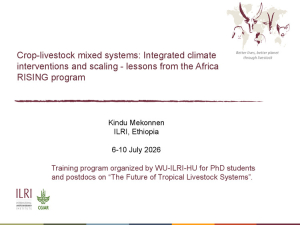
Crop-livestock mixed systems: Integrated climate interventions and scaling - lessons from the Africa RISING program