Learning from within: Pastoral innovation to scale climate adaptation in the drylands
Abstract
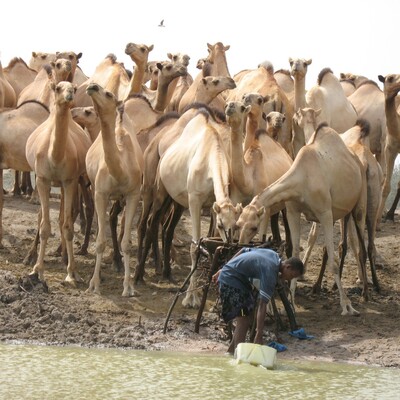
Dryland pastoral communities are on the front line of land degradation, recurrent drought, and increasingly, climate-driven flooding and displacement. Externally designed interventions — vaccination campaigns, feed distribution, infrastructure projects — have repeatedly struggled to outlast the project cycles that fund them.
Yet across drought-affected woredas in Ethiopia, a consistent body of field evidence shows that some pastoral households consistently achieve better livestock health and feed outcomes than their neighbors, despite facing identical climatic and resource constraints. This is not the result of greater external support — it is the result of how these households manage knowledge, labor and risk.
This brief summarizes evidence from scoping studies and pilots in Afar, South Omo and Somali Regions applying the Pioneer Positive Deviance (P-PD) approach — a low-cost, community-owned methodology for identifying these “pioneer” households, understanding their practices, and connecting them to peers through existing knowledge networks rather than new external infrastructure.
For UNCCD stakeholders, the central message is this: dryland resilience strategies do not need to start from a deficit. They can start from what is already working — and invest in finding it, validating it, and helping it travel.
Citation
Habermann, B., Worku, T., Getahun, E., Lemma, M., Flintan, F., Adie, A., Berhanu, D., Knight-Jones, T., Alemu, B., Achandi, E., Feki, E. and Temesgen, W. 2026. Learning from within: Pastoral innovation to scale climate adaptation in the drylands. Nairobi, Kenya: ILRI.
Authors
Related Publications
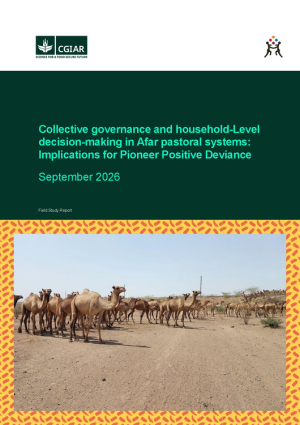
Collective governance and household-Level decision-making in Afar pastoral systems: Implications for Pioneer Positive Deviance