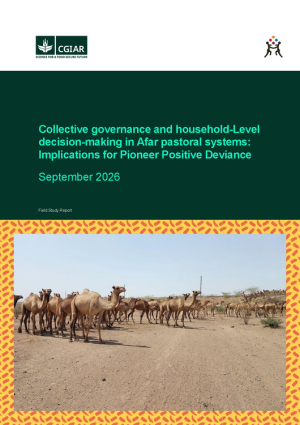
Qualitative identification of Pioneer Positive Deviant households for animal health and feed/forage management in Afar, Ethiopia
Abstract
This field study applied a qualitative and participatory approach to identify and preliminarily validate Pioneer Households implementing successful livestock health and feed/forage management practices in Sabure and Dudub kebeles of Awash Fentale Woreda, Afar Region, Ethiopia. The sequential process combined key informant interviews, gender-disaggregated community workshops, independent community validation, household interviews, transect walks, field observations, and a Pioneer Household Validation Matrix. The process identified 87 potential Pioneer Households, shortlisted 40, and preliminarily identified 27 Pioneer Households, 11 in Sabure and 16 in Dudub. Community-identified practices included grazing and livestock mobility, feed and forage management, livestock health management, and parasite and disease management. The fieldwork demonstrated the value of combining community knowledge with household-level verification and highlighted the need to adapt P-PD methods to pastoral mobility, seasonal variation, and the limited visibility of some practices. The findings provide a basis for further qualitative analysis of Pioneer Households and their practices.
Citation
Worku T., Getahun, E., Lemma, M., Adie, A., Berhanu, D., Habermann, B. and Achandi, E. 2026. Qualitative Identification of Pioneer Positive Deviant Households for Animal Health and Feed/Forage Management in Afar, Ethiopia. Field Study Report. Nairobi, Kenya: ILRI.
Authors
Related Publications
Impact evaluation of a small ruminant flock health intervention on animal health, welfare, and farmer income in Ethiopia
Prevalence, quantification, and household-level risk factors associated with Salmonella spp. infection in chickens in Boussouma commune, Burkina Faso