
ILRI researcher awarded USD 1.45 million grant to advance AI-driven data analyses for genomics surveillance in low and middle income countries
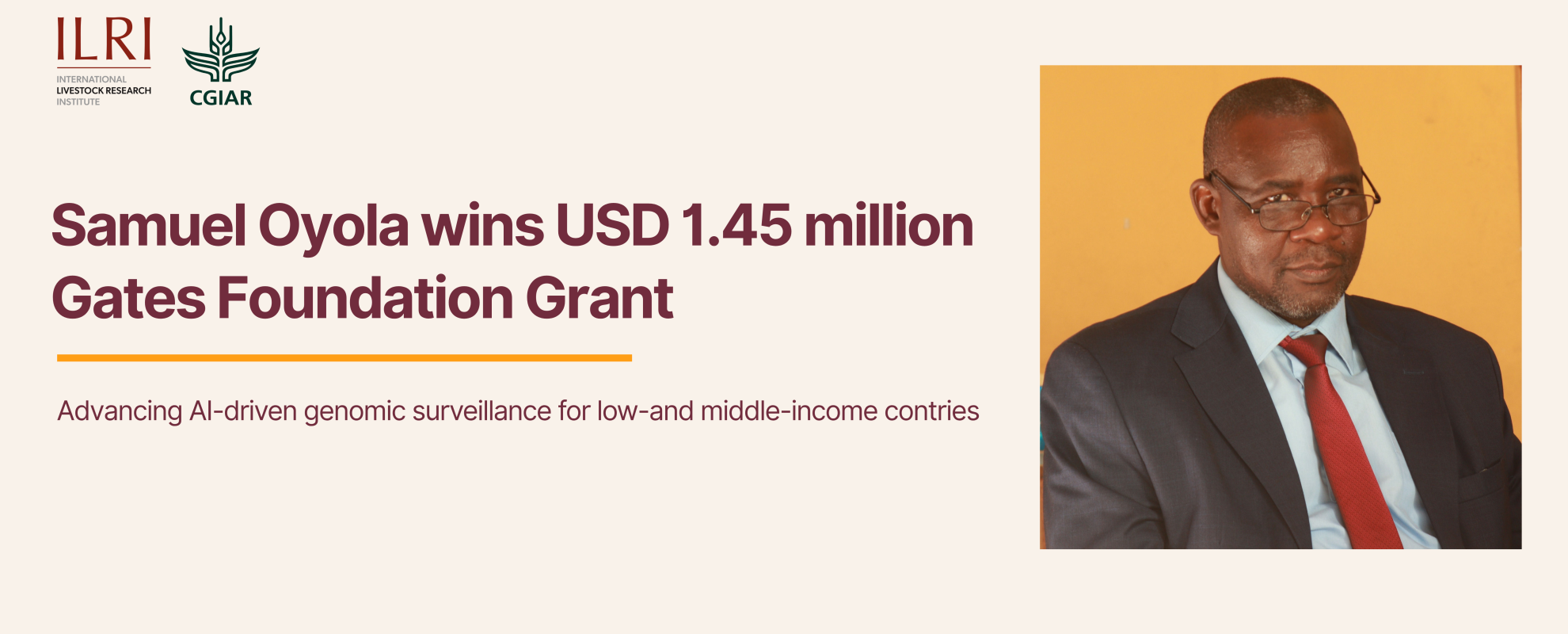
The International Livestock Research Institute (ILRI) is pleased to announce that Samuel Oyola has been awarded a USD 1.45 million grant from the Gates Foundation to lead an innovative research program aimed at strengthening data analytics, epidemic intelligence and and public health decision making through the integration of wastewater genomic surveillance, clinical data, and artificial intelligence (AI).
The project , titled “Deploying AI Innovation for Bioinformatics and Genomic Epidemiology,” will build on ILRI’s pioneering wastewater environmental surveillance platform that has been operating continuously for the past three years across urban centers in Kenya.
The initiative leverages a large longitudinal dataset generated from high-frequency wastewater sampling and shotgun metagenomic sequencing across 30 urban catchments. By integrating environmental genomic data with clinical infectious disease and AMR datasets, the project aims to develop predictive AI-driven models capable of identifying outbreak signals and emerging antimicrobial resistance trends earlier than conventional surveillance systems.
Speaking about the award, Oyola noted that the project represents an important step toward the development of scalable, data-driven public health systems for Africa and other low- and middle-income settings.
“This work brings together waste water surveillance, genomics, epidemiology, artificial intelligence, and public health to create practical early-warning systems capable of detecting disease threats and antimicrobial resistance in near real time. The vision is to transform complex genomic data into actionable public health intelligence that supports faster and more informed decision-making,” said Oyola.
The project aligns closely with global priorities on pandemic preparedness, integrated disease surveillance, and AMR mitigation. It will combine advanced metagenomic analytics, machine learning, and interpretable AI approaches to model pathogen transmission dynamics and resistance patterns at population level.
Key outputs of the project are expected to include:
- AI-enabled predictive models;
- Integrated environmental and clinical surveillance datasets;
- Practical frameworks for incorporating wastewater-based epidemiology into routine public health systems;
- Policy guidance and implementation tools for Ministries of Health, Livestock, Environments and surveillance agencies; and
- Capacity strengthening in genomic epidemiology and AI-driven public health analytics.
As part of the grant, the program will also support two fully funded PhD positions and a postdoctoral candidate focused on the intersection of genomics, modelling, and public health decision making. The candidates will be based at ILRI Nairobi and will work closely with international collaborators at the University of Oxford and the Global Pathogen Analysis Platform (GPAP) at the Technical University of Denmark (DTU). The projects will contribute to the development of next-generation “agentic AI” systems capable of automating genomic analyses and generating real-time public health insights through interactive surveillance dashboards and decision-support tools.
ILRI has emerged as a continental leader in genomic surveillance and wastewater-based epidemiology, supporting African Union member states through training, capacity development, and implementation of innovative surveillance technologies. The institute’s wastewater surveillance program has already processed thousands of samples and generated extensive pathogen and antimicrobial resistance profiles to support public health preparedness and response.
This new Gates Foundation funding further strengthens ILRI’s role as a regional hub for advanced genomics, AI-enabled surveillance, and translational research.