Why the conversation about livestock and hunger needs to change
Iowa State University, the International Livestock Research Institute and the University of California, Davis make the case in two sessions at this year's World Food Prize Foundation's Borlaug Dialogue
October 5, AMES, Iowa – Livestock keep an estimated 1.7 billion people fed, employed, or both. Yet in most conversations about ending hunger, livestock shows up only as a caveat: something to offset, scale back or work around. That framing is increasingly out of step with where the need and the opportunity actually sit: demand for meat, milk and eggs across Africa and Asia is projected to grow by as much as 200% by 2030. The open question is therefore how smallholder farmers and pastoralists in low- and middle-income countries (LMICs) can be best supported to sustainably meet that demand.
Getting there means moving past the same polarized fights about livestock that focus on meat versus plant-based foods, emissions versus livelihoods, and building something more useful in their place: a conversation that's inclusive, evidence-based, and focused on solutions and action rather than picking sides. Two sessions at the upcoming World Food Prize Foundation’s 2026 Norman E. Borlaug International Dialogue in Des Moines will tackle this discussion head on, focusing on how changes in livestock systems can help combat hunger worldwide while also protecting our planet.
A conversation that hasn't kept up with the evidence
Investment hasn't caught up either. Livestock typically receive less than 1% of total official development assistance and of climate development finance. Funders, scientists, farmer leaders and policymakers rarely make the case in the same room for closing that gap, and the agroecology, food sovereignty and social justice movements are rarely invited in at all.
The deep dive session, “Can We Change the Livestock Conversation Before Hunger Wins?” puts that question to a panel that doesn’t often share the stage:
- World Food Prize Laureate Jan Low
- Malawi's Minister of Agriculture, Irrigation and Water Development Hon. Roza Fatchi Mbilizi
- the SDG2 Advocacy Hub's Paul Newnham, and
- the Eastern Africa Farmers Federation's Joyce Kamau
The focus of the discussion will be on what it would take to build a more inclusive, evidence-based conversation on livestock, and who should be part of it. It will consider the changing funding landscape, bring together perspectives that are too often discussed separately, and identify opportunities to move from fragmented efforts toward greater alignment and scalable delivery.
"Livestock has been left out of too many rooms where decisions about hunger get made. If the science, the policy and the people living this reality don't start talking to each other properly, we'll keep circling the same debates while the opportunity in front of us slips away," explains Professor Appolinaire Djikeng, Director General of the International Livestock Research Institute (ILRI).
That conversation is meant to outlast the week. It continues through Livestock Futures, a new ILRI evidence series built to keep the alignment, funding and follow-through going across priority geographies long after Des Moines.
Proven solutions, still waiting to scale
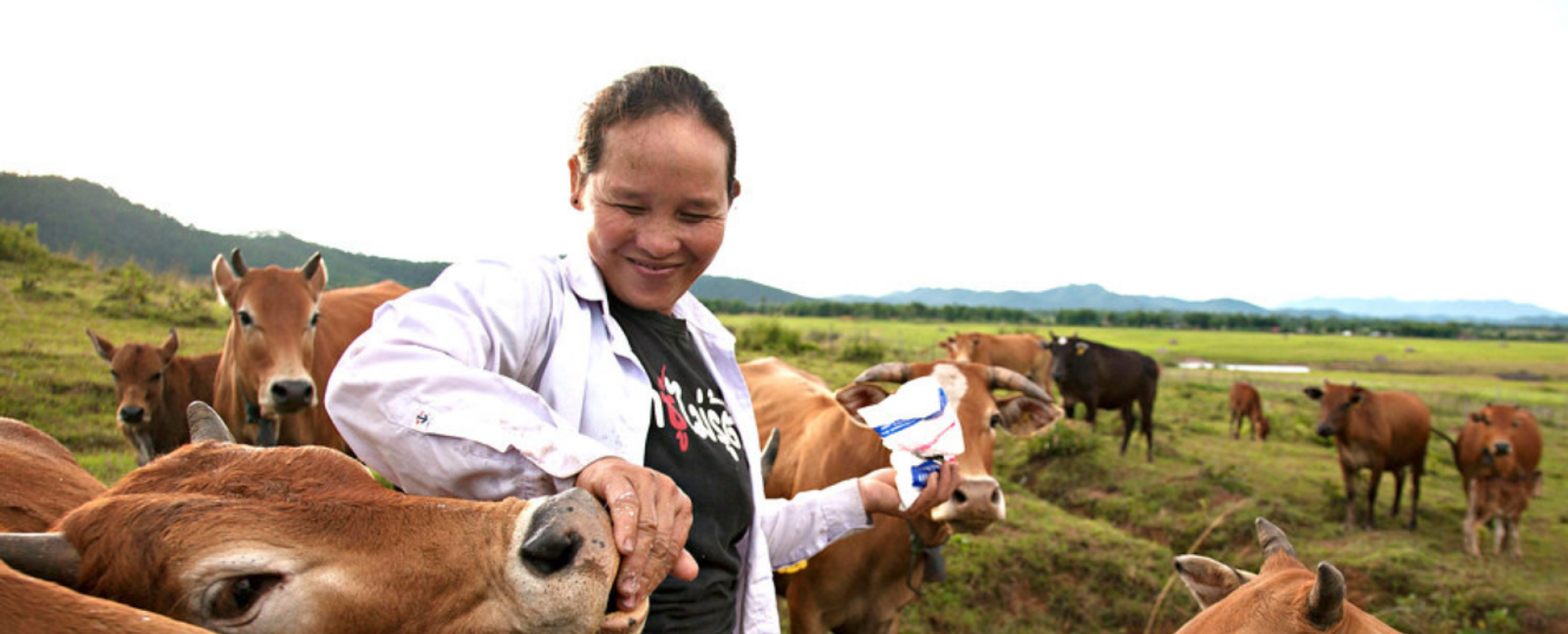
Two-thirds of the developing world's poor livestock keepers are women, and much of the technology built to serve them still doesn't reach the scale it needs to. Sex-sorted semen technology has already improved dairy productivity for farmers in Ethiopia, through work led by Iowa State's Curtis Youngs; the University of California, Davis’ Mark Bell has spent his career on what it takes to move innovations like it from pilot to widespread use. Both will speak at the evening side event, alongside a panel of farmer, private-sector and development voices — including Joyce Kamau from the Eastern Africa Farmers Federation, Christa Hoffman from URUS Group, Maya Rajasekharan from the Alliance Biodiversity & CIAT, and Oscar Castañeda, Senior Vice President, Americas, Heifer International — on what's still missing to get proven solutions to scale.
Women farmers and entrepreneurs who couldn't travel to Des Moines will also be part of that conversation, through short video contributions on the role livestock plays in their own food security and livelihoods.
"Too many good ideas in this space die at the pilot stage because nobody connects the science to the people who can actually scale it — investors, policymakers, the private sector. That's the gap this session is built to close," said Professor Ermias Kebreab, director, World Food Center, Sesnon Endowed Chair Professor, UC Davis.
Participants will also be invited onto an online platform to register interest, share a specific ask or commitment, and help shape the Livestock Futures flagship series before, during and after the event.
Event details
- Deep Dive: “A New Livestock Conversation — Before Hunger Wins.” Oct. 21, 2:15–2:45 p.m. Iowa Events Center Community Choice Convention Center. Open to registered Borlaug Dialogue attendees.
- Side event: “Deploying Livestock Solutions for Nutrition, Climate and Sustainable Development.” Oct. 21, 6:15–8:15 p.m. Same venue.
Registration and the full agenda for both sessions are available on the 2026 Borlaug Dialogue webpage.
##
Notes to editors
For any questions or requests for interviews, please contact:
- Anne-Marie Schryer-Roy, International Livestock Research Institute, A.Schryer-Roy@cgiar.org
- Curt Youngs, Iowa State University, cryoungs@iastate.edu
- Ermias Kebreab, University of California, Davis, ekebreab@ucdvis.edu
The International Livestock Research Institute works to improve the lives of 300M people in low- and middle-income countries through livestock science that builds resilient systems, transforming food systems with environmental benefits. ILRI is a member of CGIAR, a global research alliance transforming food, land and water systems in a climate crisis.
Iowa State University, established in 1858, is a leading public land-grant research university with internationally recognized expertise in agriculture, including animal science (livestock reproduction, nutrition, and genetics), agronomy, and sustainable food systems. Iowa State’s agriculture and forestry programs are ranked 7th globally (QS World University Rankings).
The University of California, Davis is a public research university with expertise in agriculture, veterinary medicine, animal science, plant sciences, food systems, climate solutions, biological and agricultural engineering and One Health. Its College of Agricultural and Environmental Sciences drives innovation in sustainable food systems, environmental stewardship and human health.