Designing for impact: how Nigeria’s livestock master plan forges coalitions and boosts coordination
In Nigeria, conversations about livestock often return to the same question. How can a sector with so much potential deliver more consistent value for farmers, businesses, and the wider economy?
With support from the International Livestock Research Institute (ILRI) and local and international partners, the Nigerian Government is working to answer that question by devising a national livestock master plan. The plan addresses a long-standing problem in the sector by encouraging better coordinated action across policy, investment, and implementation.
When work to develop the plan began in 2023, it did not start with a document. It started as a process. From the beginning, there was a clear intention to involve the right people early, to generate outputs that would anchor future decisions in strong evidence, and to ensure that the final outputs could be used in real policy and investment settings.
At the core of the plan is a comprehensive modelling framework that reflects important inter-relationships between animal herd dynamics, production systems, markets, animal health, and use of land, water, and feeds. What makes the plan well thought out and relevant is how the underlying data is gathered and the evidence is analyzed, said Dolapo Enahoro, a senior ILRI scientist leading the work on the plan.
Rather than relying on static and largely incomplete information, the process of developing the master plan involves collating livestock data from multiple secondary and primary sources and repeatedly validating the resulting databases with experts across government, academia, and the private sector. Assumptions of the integrated modelling framework are similarly tested, challenged, and refined to ensure that they reflect on-the-ground conditions.
The outcome for the government is a set of evidence-based pathways that show where investment will have the greatest impact across different livestock value chains and production systems.
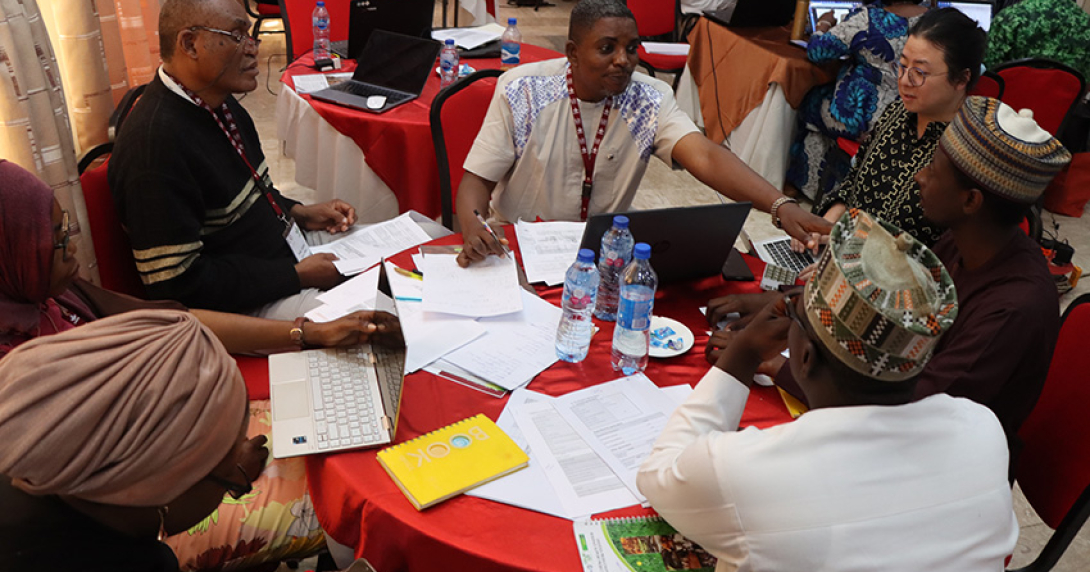
ILRI/Folusho Onifade
Livestock experts during an N-LMP workshop session in Nigeria.
“The credibility of the plan hinges on the rigor of the analysis."—and when stakeholders and decision makers contribute to and recognize that rigor, it gives them confidence to act on the results, said Dolapo Enahoro, senior ILRI scientist.
Building a coalition for change
Recognizing that no single institution can single-handedly transform Nigeria’s livestock sector, the development phase of the plan brought together actors from across the system.
This is no one-off consultation.
“We spend considerable time scoping out the relevant stakeholders both for developing the plan and for its eventual implementation, and we engage them from the beginning and throughout the process,” Enahoro said.
Technical experts from across the country worked together, alongside international partners, to review and validate baseline data drawn from multiple sources, generating new evidence through the process. During workshop sessions, government officials, researchers, and industry actors applied their knowledge and vast experiences to the processes of testing assumptions, checking data gaps, and refining the collective understanding of Nigeria’s livestock systems.
Participants also mapped key value chains, identified priority areas for investment, and examined how different actors and processes interact and shape outcomes within the sector.
Private and public stakeholders played an important role in grounding the analysis in practical realities, helping ensure that the findings reflect how the sector operates and can support ongoing and future decision-making.
By 2025, many critical stakeholders at both national and subnational levels were already familiar with the strategic direction, objectives, and early recommendations of the plan, in some cases having directly contributed to these.
“This process has reduced resistance and built broader ownership of the plan across a wide coalition of stakeholders,” said Oladeji Bamidele, lead national consultant working on the livestock master plan, during a presentation at the first National Council on Livestock Development.
This growing coalition has been central to early uptake. The Federal Ministry of Livestock Development is now integrating the plan into its broader strategy. State governments are beginning to request support for localized implementation.
Nigeria’s approach has also been shaped by lessons from other countries.
Through peer-to-peer exchanges, government officials and technical teams in Nigeria have drawn on experiences from Ethiopia and Tanzania, where livestock master plans have been informing policy and investment decisions since the 2010s. Study visits and knowledge-sharing platforms have enabled direct learning on what works, what does not, and how to adapt strategies to different contexts.
Shared experience can strengthen national planning processes, Enahoro said.
“The focus is to bring together decision makers from different countries to learn from each other.”
Moving from momentum to implementation
Nigeria’s livestock sector will not change overnight. It is large, diverse, and closely tied to wider economic and social realities. There are, however, early signs that a more coordinated approach is taking shape.
In early 2025, technical experts reviewed and vetted the final results of a sector-wide analysis, ensuring that the evidence base was both comprehensive and widely accepted. This was followed by high-level engagements with national leadership, aligning the plan with broader reform agendas.
State-level workshops in Adamawa and Oyo ensured that the plan reflected local realities and priorities. A study tour to Tanzania provided practical insights into implementation. Technical discussions with ministry officials helped integrate insights from the plan into Nigeria’s 10-year livestock growth strategy.
By mid-year, the draft plan was already shaping national decision-making. Its data and analytical outputs were used to support strategy development, guide investment discussions, and inform institutional planning.
In September, the validated Livestock Sector Analysis and Strategy were formally handed over to the Nigerian government, marking a shift from the development to implementation phase. The inauguration of the National Council on Livestock Development later in the year further strengthened coordination across federal and state levels.
The baseline data and analysis have been accepted by technical stakeholders and are now feeding into the Nigeria Livestock Growth Acceleration Strategy. During a high-level stakeholder engagement convened by the Federal Ministry of Livestock Development in early 2026, the plan was extensively discussed, informing investment planning, feed development, and animal health.
There are already signs of how these efforts are taking hold. The livestock strategy informed by the master plan has been shared with commissioners in states participating in the ILRI-led Livestock Productivity and Resilience Support (LPRES) project, which also spearheads the work on the development of the livestock master plan.
In addition, elements of the national plan are beginning to appear in state-level work plans developed by government-supported livestock projects. This is an important step in moving from planning to coordinated action across the country.
As Sanusi Abubakar, national project coordinator of LPRES, noted, “The five-year livestock strategy has already been socialized with some state commissioners, and they have incorporated it into their work plans across 20 states. With support from the ministry, we are hopeful this will extend to all of Nigeria’s 36 states.”