Birgit Habermann

Birgit Habermann

Scientist, Climate Change Technologies in Practice

Birgit Habermann joined ILRI in March 2019. She has been working on social issues and Participatory Action Research (PAR) since 2000 in agriculture, forestry, livestock and biodiversity/conservation in different parts of World (Europe, East Africa, South, SE and Central Asia). 

Her current work focuses on:

  • user-centred design
  • co-production for collaborative research
  • social learning. 

She uses different concepts and tools such as positive deviance, actor network theory, citizen science and living labs to highlight the importance of farmer-led innovations and the re-framing of the adoption paradigm. For more information about this work, check out the following pages:

> https://www.ilri.org/adaptation-pioneers

Together with her team and many partners, she works on making farmer-led innovations available for scaling with pioneer farmers, co-designing farmer-led extension materials and record keeping tools. 

Her background comprises degrees in ecology (Univ. of Vienna, Austria) and agroforestry (Bangor Univ., UK) as well as a PhD in Development Studies (IDS, Sussex Univ. , UK). Apart from her roles as a researcher, trainer and facilitator, she has experience in research management, funding and programme management as well as managing director in the non-profit sector.

My Blog Posts

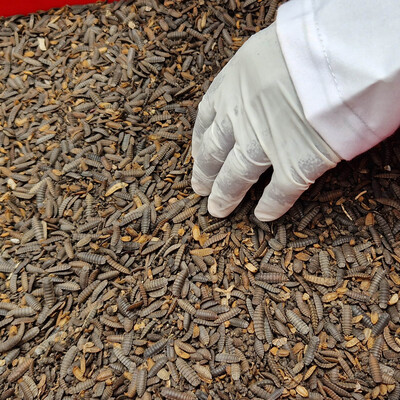
Black soldier fly larvae

ILRI News

If you look for local innovations, you will find them: Exciting next steps for the Living Lab for People in Nandi County

Field day participants learn from an adaptation pioneer (photo credit: ILRI).

ILRI News

Farmer-led approach supports socially inclusive innovations in Kenya's dairy sector

Field day participants learn from an adaptation pioneer (photo credit: ILRI).

ILRI News

Farmer-led approach supports socially inclusive innovations in Kenya's dairy sector

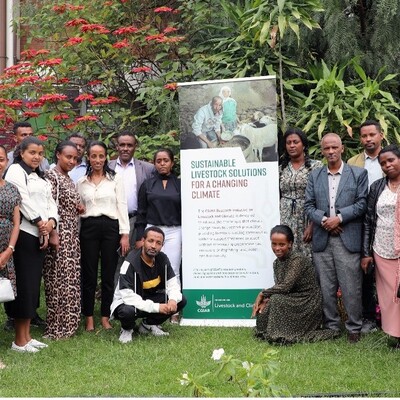
Workshop participants on ILRI’s Addis Abeba campus. Photo by M.Mulatu/ILRI.

ILRI News

Adaptation and mitigation for livestock: a multidisciplinary approach in response to climate change

Adaptation Pioneers Cornelius and Monica Kosgei help Esther Omayio in preparing demonstration on feed formulation. Photo by B.Habermann/ILRI.

In the field: Listening to adaptation pioneers

A cattle rancher with a herd of Nelore short cycle cattle at the Hacienda San José in Colombia.

Impact

Testing the climate adaptation pioneer approach in Colombia

My Projects

Living Lab for Low Emission Food System Transformation in Nandi County

ACTIVE

Living Lab for Low Emission Food System Transformation in Nandi County

Pasture on smallholder farm in Bomet county

ACTIVE

HABITAT Smallholder pasture management and biodiversity in the Kenyan highlands

Livestock

Programme for climate-smart livestock systems

My Publications

ILRI publication cover

Bridging silage quality gap: A study with smallholder dairy farmers

  • Maiyo, Nathan
AuthorsDraft2025AdaptLitReview.pdf.jpg

What constitutes climate change adaptation in Kenyan livestock systems: a systematic review

  • Kihoro, Esther
unlocking_rio_nexus_infographic.pdf.jpg

Unlocking the Rio nexus – How sustainable transformation of food, land and water systems can turn the tide of land degradation, climate change and biodiversity loss while enhancing social gains

  • Upla, P.
agroecology_infographic.pdf.jpg

Agroecology in livestock systems in low- and middle- income countries: Managing synergies and trade-offs

  • Masso, C.
Outcome Brief_KEN_Partners_Jan2026.pdf.jpg

Building user-centered collaborative research in Nandi and Bomet counties, Kenya

  • Gichuki, Leah
Net mapping tool guide.pdf.jpg

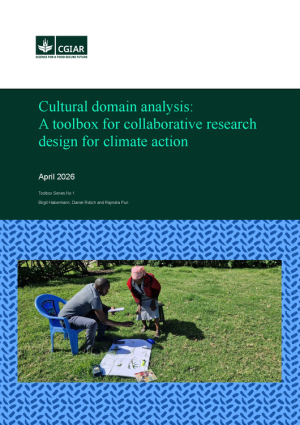
A Practical Guide to the Net-Map Approach: A Toolbox for Collaborative Research Design for Climate Action

  • Habermann, Birgit