
The 17th session of the Conference of the Parties (COP17) to the United Nations Convention to Combat Desertification (UNCCD)
ILRI at COP17 to UNCCD
As 2026 marks an important global policy moment, COP17 is a great opportunity to advance ILRI's evidence and influence on rangelands, pastoralism, livestock systems, land restoration, and climate resilience.
Some of the key objectives for ILRI at the event include:
- Advancing recognition of pastoralism and rangeland management within global, regional and national policy frameworks
- Positioning ILRI as a trusted source of evidence, innovation and practical solutions co-produced with various partners for sustainable rangelands and pastoral systems
- Shifting perceptions of rangelands from marginal, degraded landscapes to productive, climate-resilient ecosystems that foster livelihoods, biodiversity and food security
- Strengthening engagement with donors, development partners, investors, governments, CGIAR centers and other stakeholders
One can follow the proceedings of the UNCCD COP17 using the official COP17 Mongolia app for iOS and Android.
Week 1 (August 17 - 22)
As we begin the first week of UNCCD COP17, ILRI is proud to contribute evidence, partnerships and practical solutions that place rangelands, pastoralism and sustainable livestock systems at the center of efforts to address land degradation, biodiversity loss and climate change.
13:00 - 14:00
Pastoral Systems & the Rio Conventions: Science for Policy and Finance to Unlock Co-Benefits
MET 23
This side event showcases how pastoral livestock systems contribute to land restoration, climate resilience, biodiversity conservation and livelihoods. The session brings together science, policy and finance actors to examine how pastoral systems can be better recognized, valued and supported within the implementation of the Rio Conventions and related financing mechanisms.
In this regard, ILRI contributes scientific evidence and policy insights that strengthen the case for pastoral systems as nature-based solutions delivering co-benefits for land restoration, climate action, biodiversity conservation and sustainable livelihoods.
Abdrahmane Wane, ILRI Regional Director for West and Central Africa, will be a speaker on "Valuing the Contributions of Rangelands," presenting evidence on the economic, environmental and social value of rangelands to strengthen their inclusion in policy and investment decisions.
15:00 - 16:30
Investing in Pastoral Futures: Responsible Investment for Resilient and Healthy Rangelands
MET-24
This is a side event that examines how responsible investment can support sustainable rangeland management, restoration and Land Degradation Neutrality (LDN) while strengthening pastoral livelihoods. Bringing together policymakers, investors, development partners and pastoralist representatives, the session will explore how tenure governance frameworks, enabling policies and innovative financing mechanisms can align investment with pastoral realities and scale healthy, productive and resilient rangelands.
Through Fiona Flintan's participation and along with lead partner FAO, ILRI brings evidence and lessons from its work on pastoralism, rangeland governance and sustainable livestock systems.
18:00 - 19:30
The imperitive to finance landscape and territorial scale governance to achieve multiple policy-action goals
MET-01
This is a side event focused on the often-overlooked need to finance landscape governance as a prerequisite for achieving restoration, climate, biodiversity and sustainable development goals. Drawing on evidence from landscape initiatives across regions, the session will highlight how inadequate funding for coordination, facilitation and stakeholder engagement undermines effective implementation, contributes to trust deficits and delays, and leaves a significant governance financing gap. The event will explore innovative approaches for financing landscape governance and strengthening integrated, cross-sectoral action.
Through Fiona Flintan's participation, ILRI brings practical experience and evidence on landscape governance, stakeholder engagement and integrated natural resource management. Partners include UNU-IAS, IPSI, EcoAgriculture Partners, 1000 Landscapes for a Billion People Initiative, UNDP, CGIAR, Yolda Initiative and Ambition Loop.
08:30 - 10:00
Countermapping pastoralism
MET-02
Bringing together pastoralist leaders, scientists, NGOs, and policymakers, the event will foster a multi-stakeholder dialogue on embedding mobility in land governance systems. It will also contribute to advancing the Rio Conventions’ nexus by demonstrating how pastoral mobility supports climate adaptation, biodiversity conservation, and land degradation neutrality. Ultimately, the session argues that recognizing and mapping mobility is not only a technical exercise, but a political and institutional shift, one that is essential for achieving inclusive, resilient, and sustainable dryland landscapes.
Fiona Flintan will be presenting with Paulina Ngurumwa, community development specialist, on the Tanzanian mapping approach. Lead partners include CIRAD, along with ILC and IPs.
15:00 - 16:30
Rangland Restoration Champions
MET-07
As part of the IYRP, the Rangeland Restoration Awards were launched to recognize individuals, communities, and groups, organizations whose work - on the ground, field level activity, through policy, or advocacy - has advanced rangeland restoration and management anywhere in the world. Nominations opened on 1 April 2026 and closed on 31 May 2026, drawing entries submitted by applicants themselves or by nominating institutions and agencies. A seven-member steering committee, drawing on representatives from FAO, ILRI, and IYRP Regional Support Group experts, reviewed submissions against criteria including measurable impact on the extent of land restored, livestock and livestock keepers benefited, biodiversity outcomes, and the strength of the underlying practice, policy, or community action.
Twenty awardees were selected globally, each receiving a certificate today. Their profiles and best practices are being showcased here today, to give their work the visibility it deserves and to inspire wider adoption of these practices across rangeland communities worldwide.
18:00 - 19:30
Launching the Drought Action Catalyst Strategy
MET-04
This is an IWMI-led CGIAR initiative launched following UNCCD COP16 to accelerate country and regional action on drought resilience. The strategy promotes a shift from fragmented, reactive drought responses to an integrated approach that links early warning systems, anticipatory action, climate-smart agriculture, water-food-land-livelihood security, ecosystem restoration, resilient infrastructure, social protection, policy reform and drought finance.
Fiona Flintan will be a panelist contributing expertise on rangeland governance, pastoral systems and drought resilience. Through her participation, ILRI will emphasize the importance of secure tenure, effective governance systems and community-centered approaches to ensure drought investments, restoration efforts and early action mechanisms deliver sustainable outcomes for pastoralists and rangeland ecosystems.
12:30 - 13:30
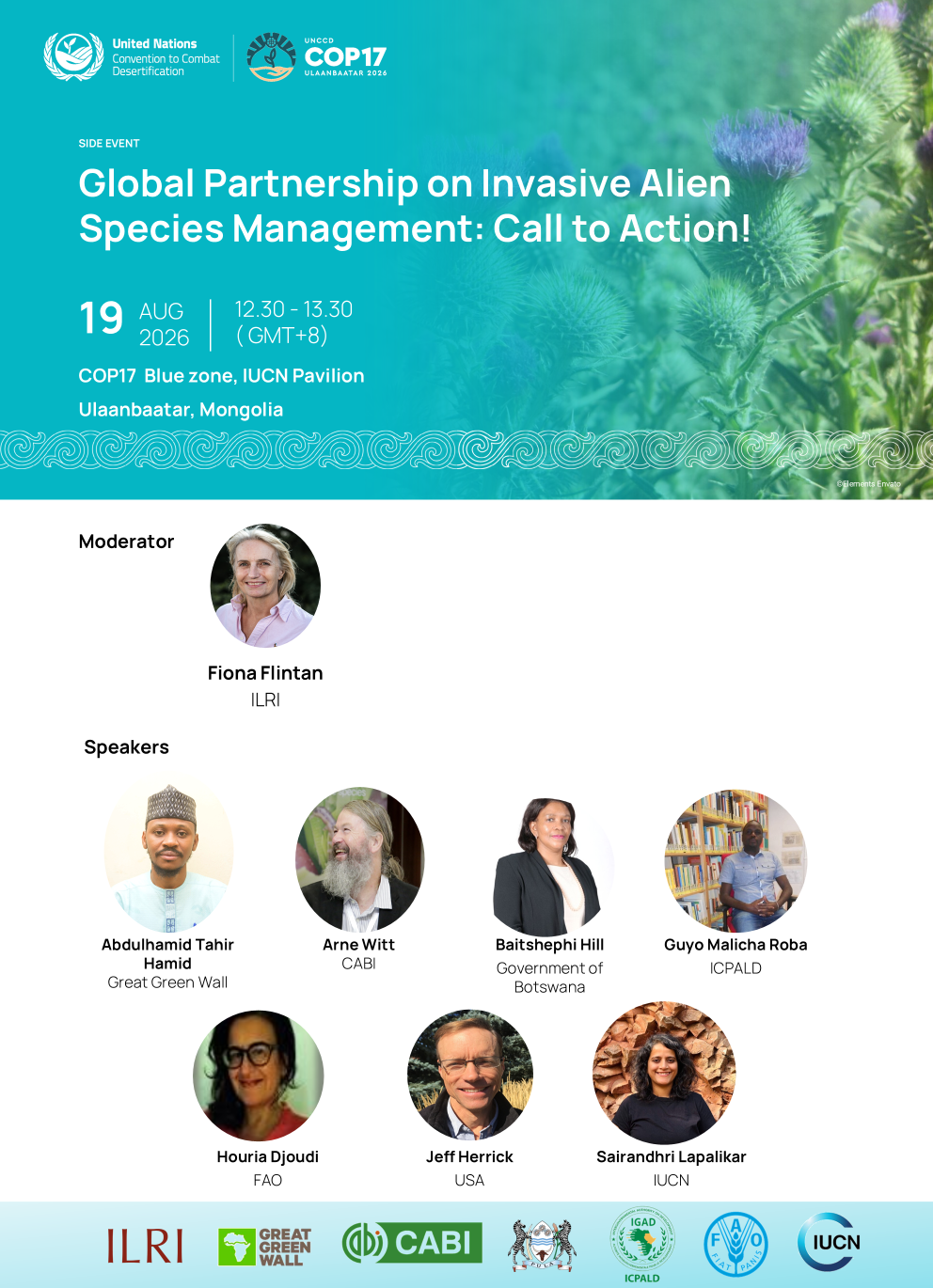
Global Partnership on Invasive Alien plan species: A Call to Action!
IUCN Pavilion
Invasive plant species are among the most significant threats to pastoralism and the biggest cause of rangeland degradation. This event will present an overview of the dire situation of invasive species spread, challenges, and their impact on land and livelihoods. Good practice strategy development and rangeland monitoring systems will be shared. Ways to incentivize private sector investment will be discussed. The event will conclude with a Call to Action on Invasive Plant Species with agreement on priority action points. ILRI is a co-organizer with CABI.
15:00 - 16:30
Restoring Drylands through Grazing Management
This side event will examine how improved grazing management can contribute to land restoration, climate resilience and pastoral livelihoods. It will bring together practitioners, researchers, pastoralists and investors working on managed grazing, rangeland regeneration, natural capital, animal production and community-based restoration.
Through Fiona Flintan's participation, ILRI will contribute its experience in participatory rangeland management.
11:30 - 13:00
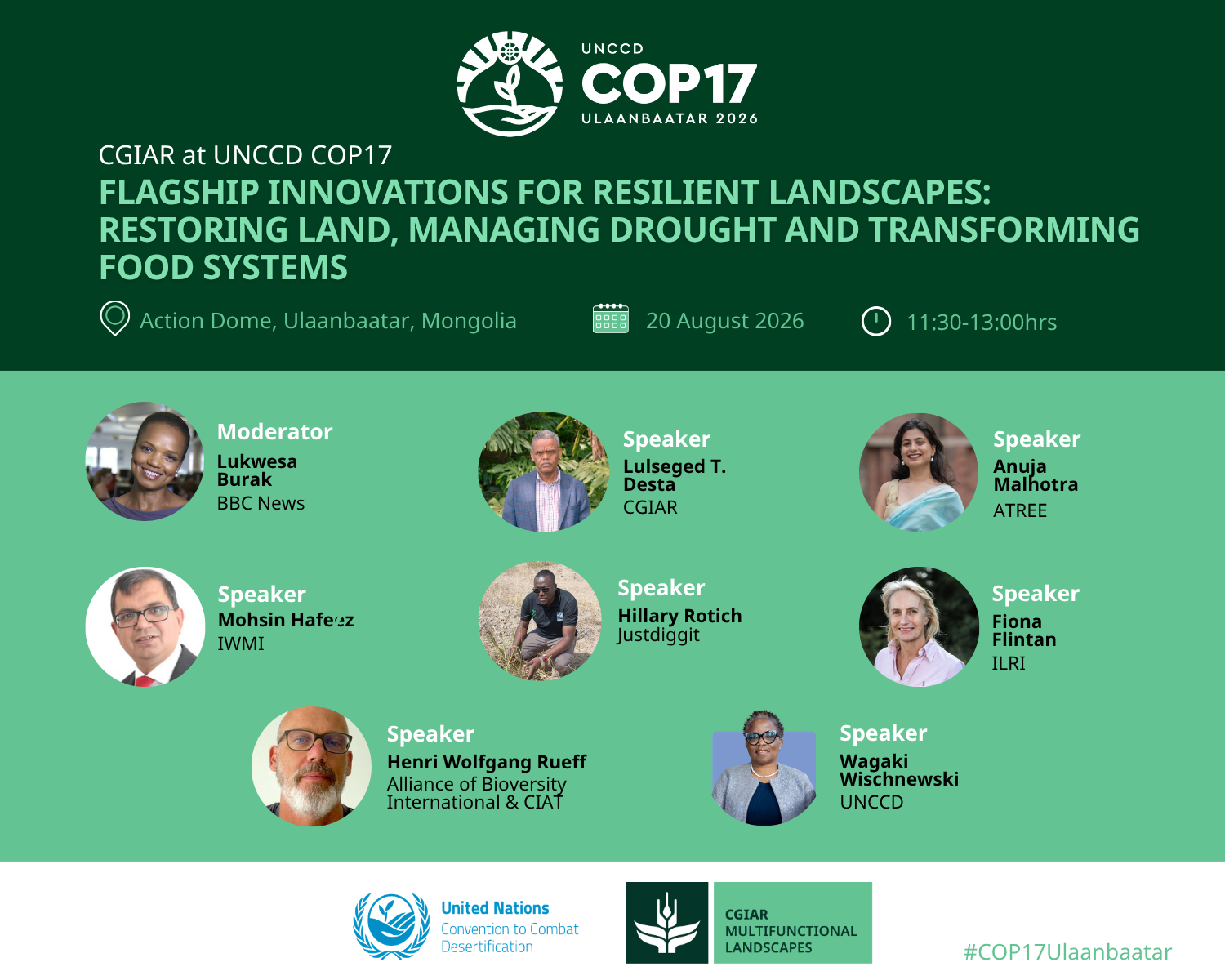
Flagship Innovations for Resilient Landscapes: Restoring Land, Managing Drought and Transforming Food Systems
Action Dome
This is a side event showcasing proven innovations that are ready for wider application in degraded and drought-prone landscapes. The session will highlight integrated restoration solutions that rebuild soil health, improve water security, strengthen rangelands, support sustainable production, create livelihood opportunities and mobilize finance for long-term resilience. It will also feature the STELARR Investment Hub as a mechanism for accelerating investment in landscape restoration and resilience.
Through the STELARR initiative and Cargele Masso's contribution, ILRI contributes scientific evidence, partnership-building expertise and investment-oriented solutions for landscape restoration.
14:00 - 15:00
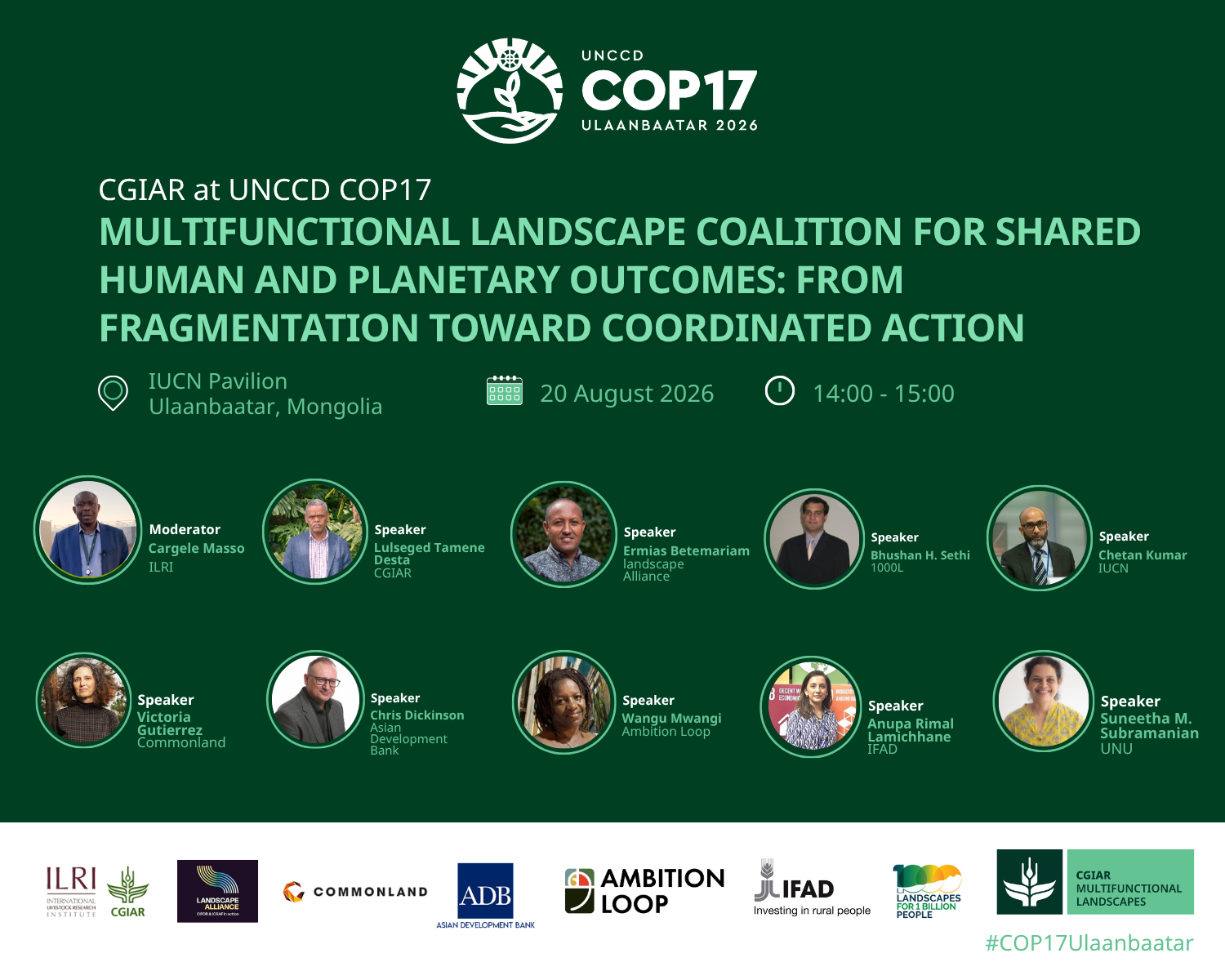
Multifunctional Landscape Coalition for Shared Human and Planetary Outcomes: From Fragmentation toward Coordinated Action
IUCN Pavilion, Blue zone
This is a CGIAR side event at UNCCD COP17 that will launch the co-creation process for a Grand Coalition of Action for Healthy Socioecological Foundations (CAHSEF). The session brings together scientists, policymakers, investors, civil society and development partners to advance coordinated action across land, water, food systems, biodiversity and climate challenges. It promotes multifunctional landscapes as key spaces where production, restoration, conservation, livelihoods, governance and finance must be planned together to achieve shared human and planetary outcomes.
Cargele Masso, Principal Scientist of Agroecological principles in Livestock systems, serves as a lead speaker, delivering the framing presentation and facilitating key discussions on landscape multifunctionality, coalition-building and integrated action across sectors.
10:30 - 12:00
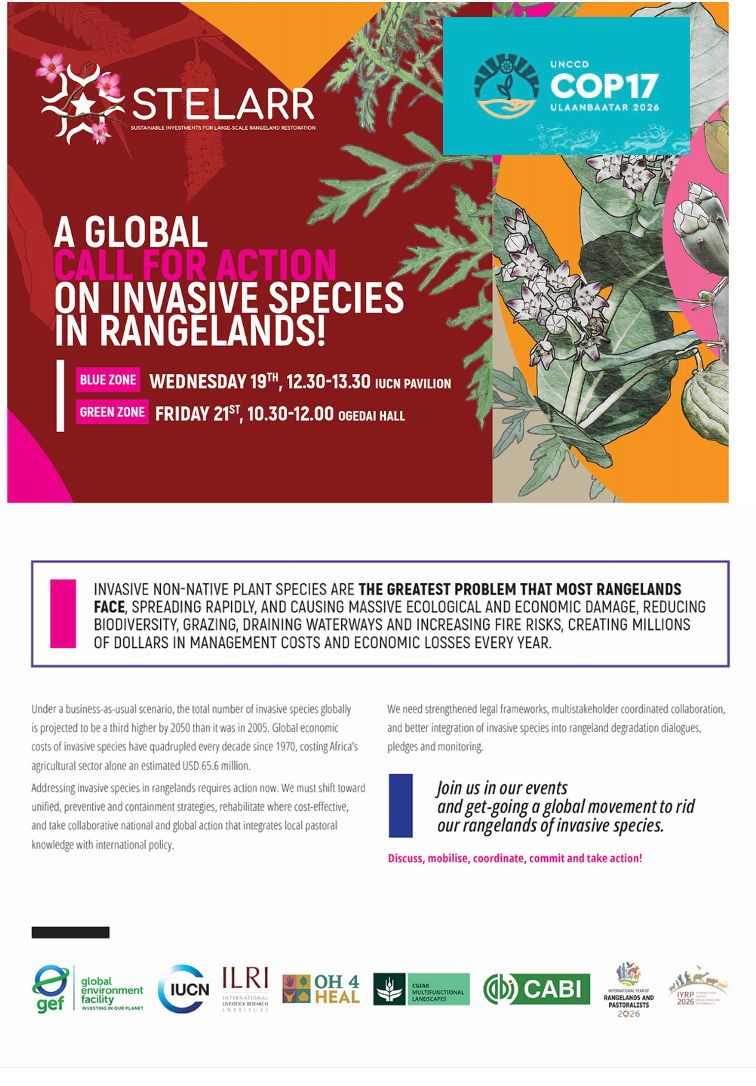
Invasive alien species: A Call to Action!
Ogedei Hall, Green Zone
This is a side event highlighting invasive plant species as one of the greatest threats to pastoralism and a major driver of rangeland degradation. Bringing together researchers, policymakers, civil society organizations and development partners, the session will examine the scale and impacts of invasive species on ecosystems, livestock production and livelihoods.
Alongside FAO, CABI and UNCCD focal points, ILRI is organizing the session and contributing evidence from its work on rangeland management, restoration and pastoral systems. ILRI also brings scientific evidence and field experience on invasive species management, rangeland restoration and pastoral resilience.
10:30 - 12:00
Implementing EU Policies: Aligning Nature Restoration and Sustainable Livestock
MET-06, Blue Zone
This is a side event focused on how rangeland and grassland restoration, sustainable pastoralism and Nature-based Solutions (NbS) can support implementation of the EU Nature Restoration Regulation, the evolving Common Agricultural Policy and the new EU Livestock Strategy.
Through Birgit Habermann's participation, ILRI brings evidence and experience on sustainable livestock development, rangeland restoration and Nature-based Solutions.
13:00 - 14:00
Grounding the Rio Conventions: Sustainable Land Management as a Pathway to Methane Mitigation
TNC Pavilion
This is a side event exploring how sustainable land management can reduce agricultural methane emissions while delivering broader benefits for land restoration, climate resilience and biodiversity. The session will examine practical methane mitigation opportunities across production systems, from rangelands to rice systems, and make the case for stronger recognition of agricultural methane within the UNCCD agenda and the Rio Conventions. Recommendations from the discussion will inform stakeholder engagement ahead of COP18.
Fiona Flintan will be a contributing speaker providing insights from ILRI's work on sustainable livestock systems, rangeland management and integrated landscape approaches.
16:00 - 17:30
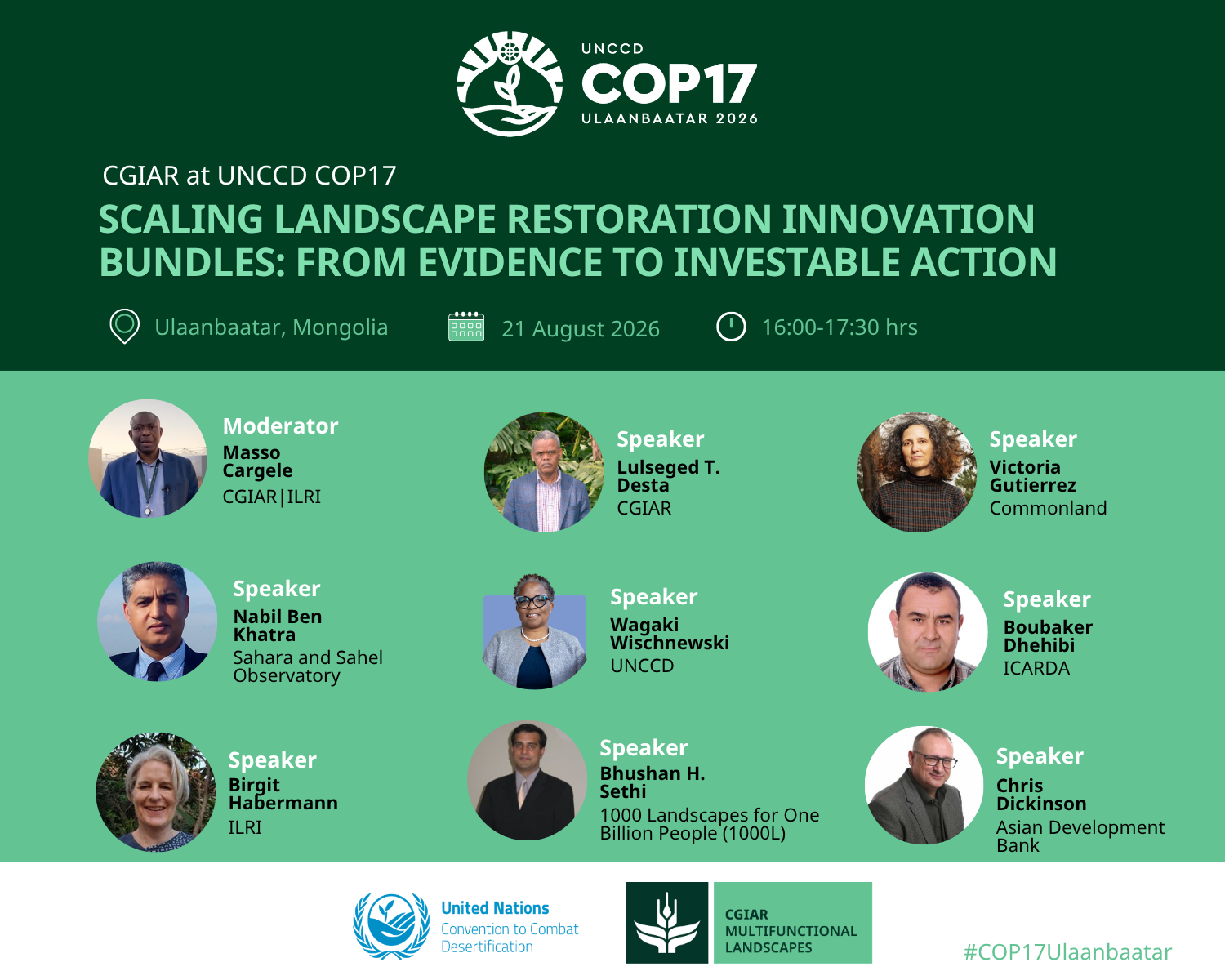
Scaling Landscape Restoration Innovation Bundles: From Evidence to Investable Action
UNCCD Action Dome
This is a side event that explores how integrated restoration approaches can help countries move from commitments to finance-ready implementation. The session highlights landscape restoration innovation bundles that combine ecological, social, institutional, financial and digital solutions to deliver multiple benefits for land restoration, biodiversity, climate resilience, water security and sustainable livelihoods. ILRI contributes scientific expertise on sustainable livestock systems, rangeland restoration and inclusive landscape management.
Cargele Masso serves as moderator, guiding discussions on how restoration innovations can be scaled through stronger evidence, partnerships, investment and implementation pathways. Birgit Habermann is a panelist discussing how women, youth, indigenous peoples, pastoralists, farmers and local communities can shape and benefit from restoration innovation bundles.
13:00 - 14:30
Managing Connectivity of Wind, Water and Livestock for Dryland Restoration
MET-03, Blue Zone
Jason Sircely will be a speaker at this side event.
15:00 - 16:30
Restore Land, Restore Hope: Bridging the Science–Policy–Finance Gap for Rio Nexus Action
MET-31, Blue Zone
18:00 - 19:30
Launch of the STELARR Rangeland Restoration Investment hub
MET-07, Blue Zone
The STELARR Rangeland Restoration Investment Hub is seeking to address these barriers by developing a more streamlined pathway between rangeland restoration opportunities and potential investors. Rather than functioning simply as a financing mechanism, the Hub is positioning itself as an enabler and connector—working with pastoralist and producer organizations, conservation actors, investors and other partners to strengthen investment cases, identify appropriate financing models and ultimately facilitate matchmaking between credible opportunities and interested investors.
Week 2 (August 24 - 28)
As UNCCD COP17 moves into its second week, the focus shifts from building the evidence base for sustainable land management to advancing the partnerships, investments and policy actions needed to deliver impact at scale.
10:30 - 12:00
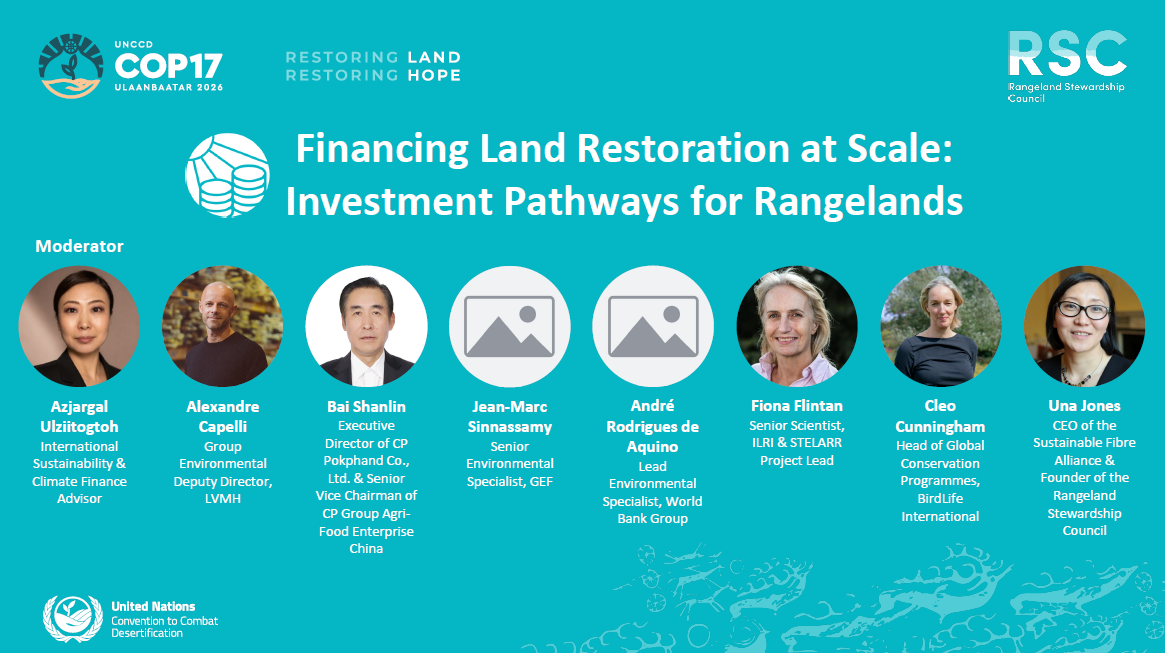
Financing Land Restoration at Scale: Investment Pathways for Rangelands
MET-03, Blue Zone
Achieving global Land Degradation Neutrality targets will require a significant shift in the way land restoration is financed. Public finance remains essential, but it is not sufficient to meet the scale of investment required. Rangeland restoration needs a broader range of investment pathways that bring together government leadership, multilateral and development finance, private sector demand, nature-based solutions frameworks, credible sustainability and investment mechanisms, scientific evidence, practical experience, and stronger project pipelines.
This session brings together speakers representing key elements of this finance architecture, including policy leadership, multilateral and development finance, private-sector demand from the luxury and agrifood sectors, science and data systems, nature-based solutions frameworks, sustainability systems, and practical experience in financing rangeland restoration across different geographies.
Fiona Flintan will be contributing to the two discussions on sources of finance and investable projects, risk reduction, lasting outcomes and alignment.
10:30 - 12:00
From Commitment to Capital: Financing Resilient Grasslands, Savannahs and Rangelands for People, Nature and Climate
MET-05, Blue Zone
This is a high-level dialogue focused on turning growing political commitment for rangeland, grassland and savannah restoration into concrete financing action. The dialogue will identify barriers and enabling conditions for investment, showcase successful locally led approaches, strengthen alignment among key stakeholders, and generate action commitments to support COP17 outcomes and the legacy of the International Year of Rangelands and Pastoralists (IYRP) 2026.
Alongside WWF and IUCN, ILRI is co-organizing the dialogue and contributing evidence from its work on rangeland restoration, pastoral livelihoods and sustainable livestock systems.

14:00 - 15:00
Beyond Restoration: Building Nature-Positive Rangeland Economies in East Africa
IUCN Pavilion, Blue Zone
This side event will be about:
- Demonstrating scalable investment opportunities emerging from the portfolio.
- Influencing the next generation of dryland financing under GCF, GEF and the upcoming Africa Green Investment Forum.
- Launching a regional platform (Coalition) to coordinate and mobilize investment into nature-positive dryland economies.
Fiona Flintan will be contributing as a speaker on the experience with the GEF-funded STELARR project.
16:30 - 18:00
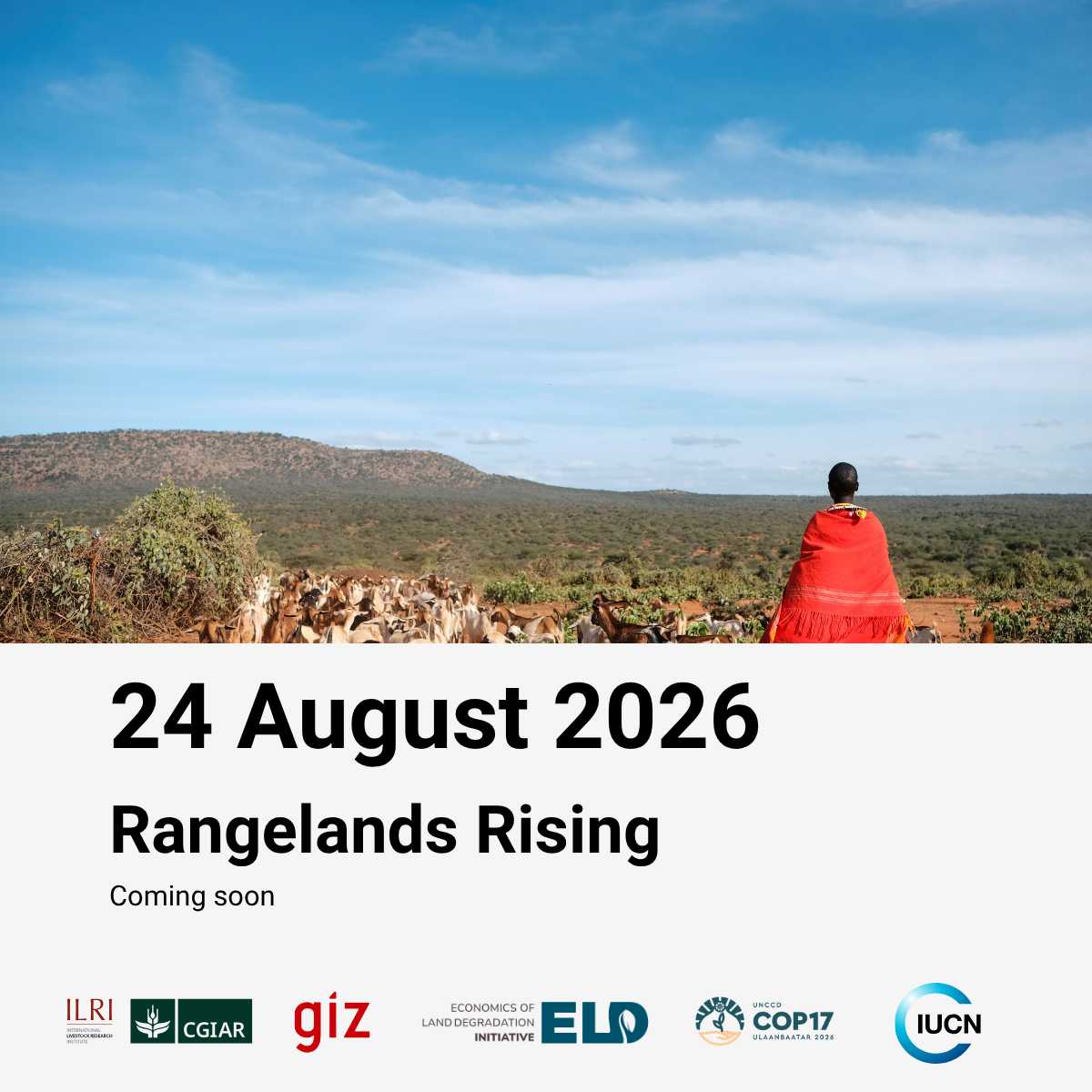
Official launch of the Rangelands Flagship Initiative | Finance Day| Official launch of Rangelands Rising Report
MET-23, Blue Zone
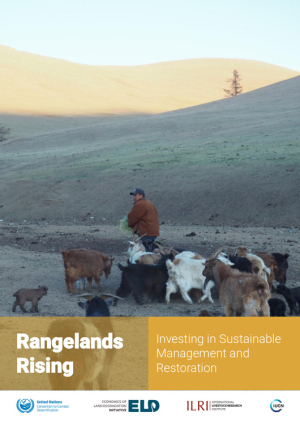
As part of the Rangelands Flagship Initiative, this session will briefly showcase the launch of Rangelands Rising, a new global report by the Economics of Land Degradation Initiative and partners, coordinated by ILRI.
Drawing on examples from Mongolia, China, Jordan, Brazil, Ethiopia, and the Sahel, the report shows how enabling policies and blended finance can unlock scalable investment in the dual livestock–nature economy.
A dedicated side event on the Rangelands Rising report will be on August 26 | 15:00 - 16:30 GMT+8 at MET-23, Blue Zone. See the schedule under the specified date and time.
11:00 - 12:00
Land, Climate and Conflict: Breaking the Cycle of Fragility in Drylands
IUCN Pavilion, Blue Zone
This session aims to position land-based solutions—particularly in drylands and pastoral systems—as a strategic entry point to address the climate–conflict–food security nexus, and to identify actionable pathways to strengthen financing for fragile and high-risk contexts, scale locally led adaptation and restoration, and reinforce the contribution of food systems and land restoration to resilience, stability and sustainable development.
11:30 - 13:00
Transforming agricultural water management for drought resilience and food security
MET-24, Blue Zone
The UNCCD COP17 Water Day provides an important opportunity to place agricultural water management at the center of the water-food nexus. The event will showcase practical solutions that strengthen drought resilience while fostering collaboration among policymakers, researchers, development partners, and financial institutions to accelerate integrated action across water, agriculture, land, climate, and biodiversity. ILRI will be contributing to a panel discussion during the event.
12:00 - 13:00
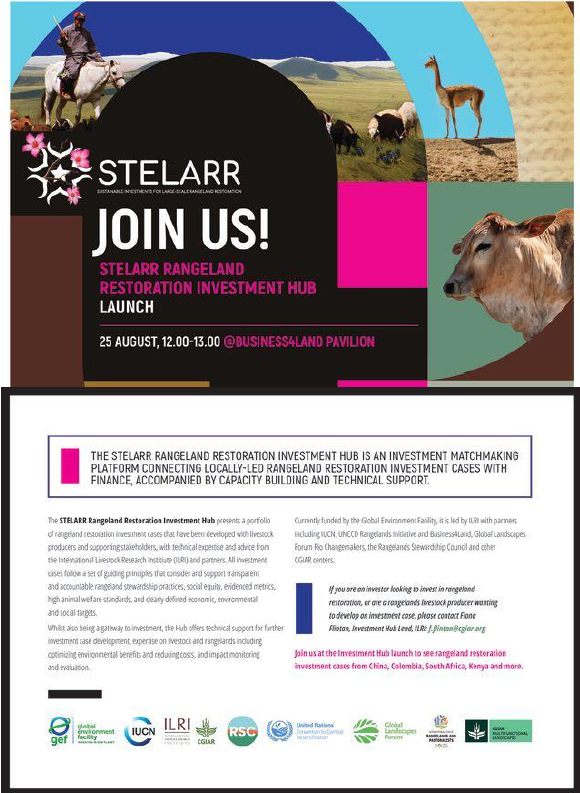
STELARR Rangeland Restoration Investment Hub Launch
Business4Land Pavilion
The STELARR Rangeland Restoration Investment Hub is an investment matchmaking platform that connects locally led rangeland restoration investment cases with finance, accompanied by capacity building and technical support.
15:30 - 16:30
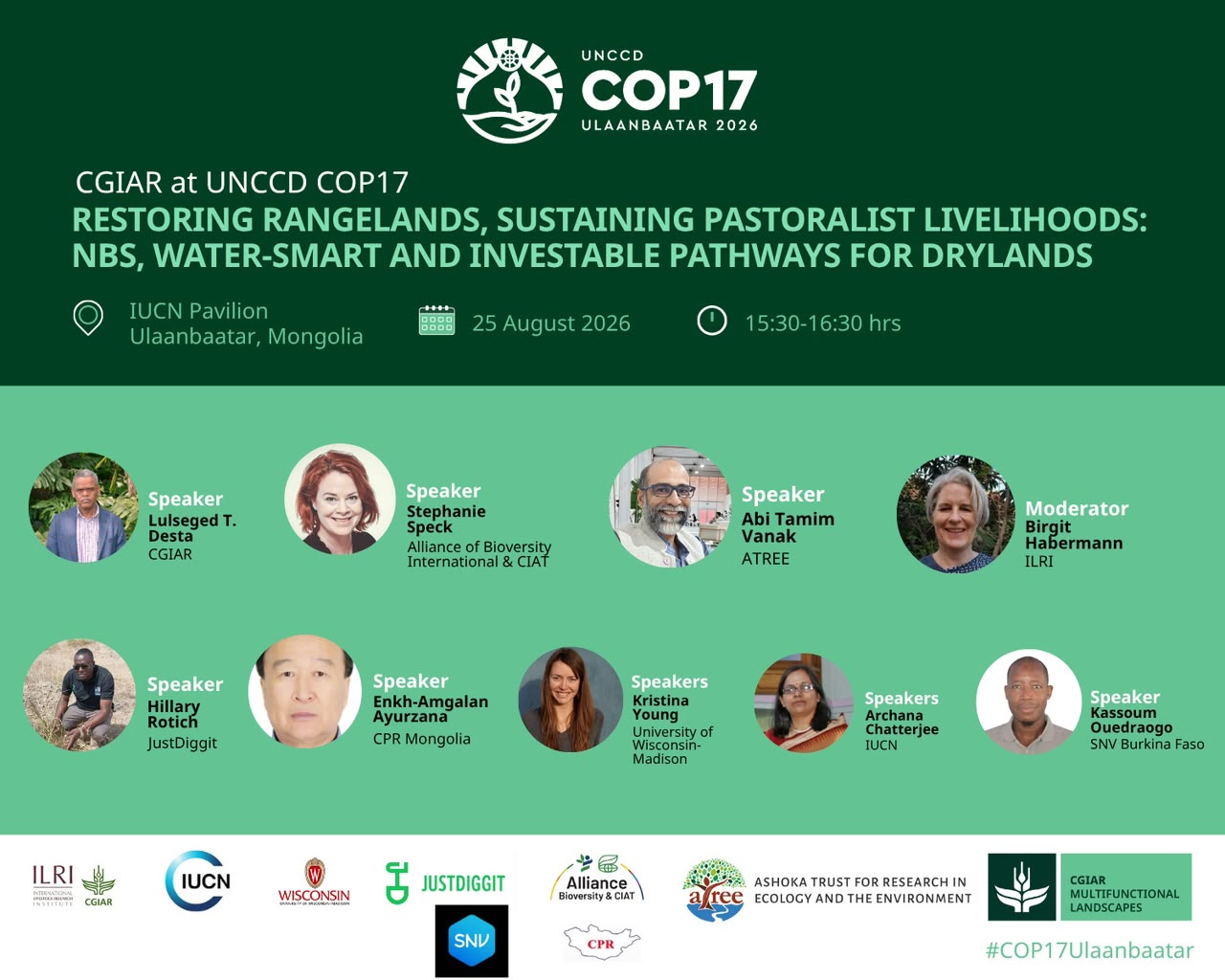
Restoring Rangelands, Sustaining Pastoralist Livelihoods: nature-based solutions, water-smart and investable pathways for drylands
IUCN Pavilion
Aligned with the theme of UNCCD COP17, “Restoring Land, Restoring Hope,” this side event will examine how nature-based, water-smart approaches can restore dryland rangelands while strengthening pastoralist livelihoods, food systems, soil health, and drought resilience. It will connect science, pastoralist knowledge, policy, governance, and finance to scale community-led restoration, secure mobility and tenure, and develop investable livestock value chains that support land degradation neutrality. Birgit Habermann will be key contributors to the discussion in this side event.
10:30 - 12:00
Launch of the Global Rangelands Standard
MET 03, Blue Zone
The launch of the Global Rangelands Standard's foundational framework at UNCCD COP17 comes at a critical moment. COP17, hosted by Mongolia during the International Year of Rangelands and Pastoralists, provides a unique opportunity to elevate rangelands within global policy discussions and move from recognition to implementation. Land & People Day offers a particularly relevant platform, given its focus on livelihoods, land stewardship, community engagement, and inclusive approaches to land restoration.
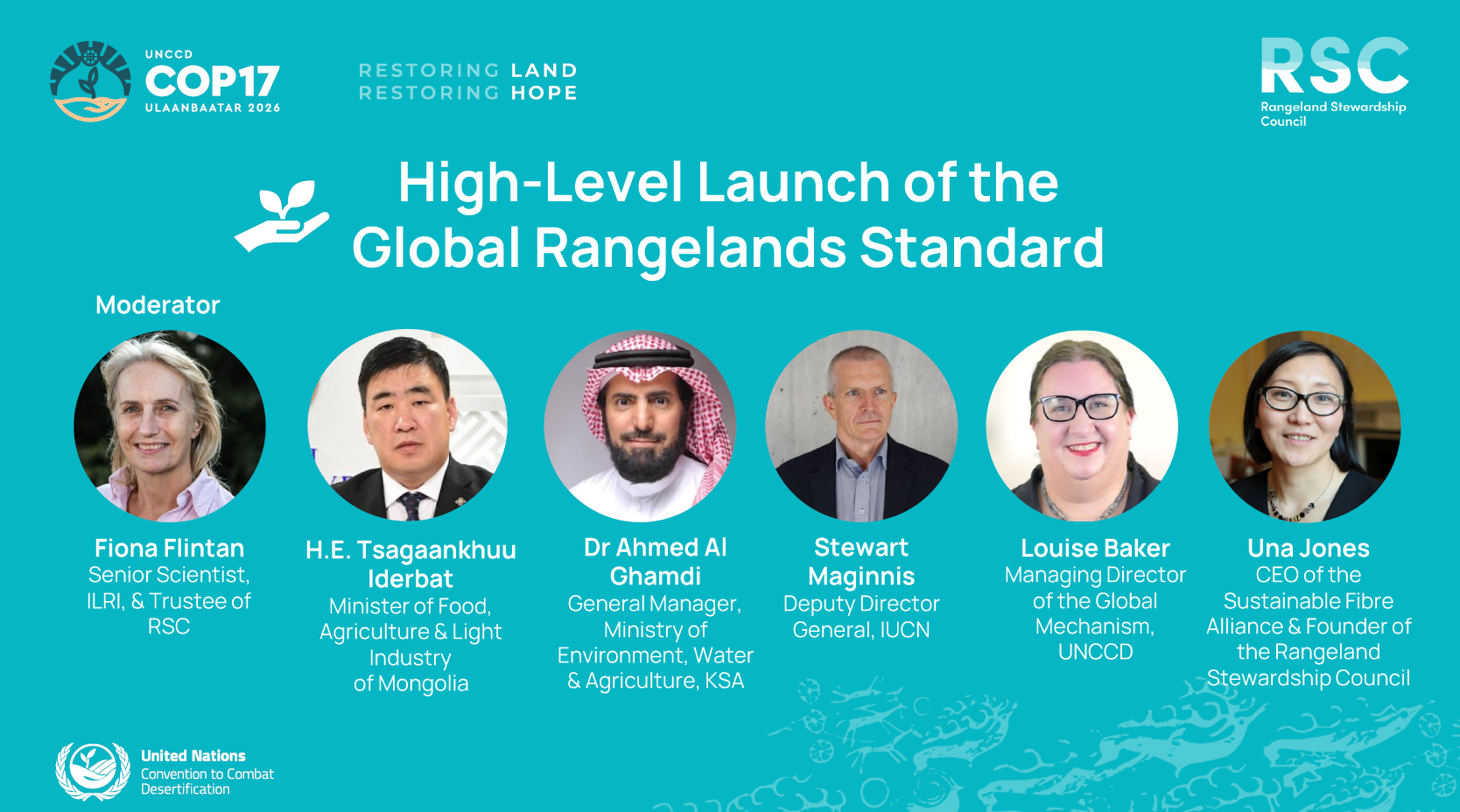
This high-level session will formally launch the Standard's foundational framework and position it as a practical mechanism to support governments, communities, businesses, investors, and partners in delivering on commitments related to land, climate, biodiversity, and livelihoods. It will bring together political leadership, technical expertise, private-sector demand, financial perspectives, and pastoralist and producer voices to demonstrate how the framework can support coordinated action and implementation at scale.
ILRI, along with partners such as Sustainable Fibre Alliance, UNCCD, Landscape Alliance, and various government, private-sector, and pastoralist communities, will lead the session.
15:00 - 16:30
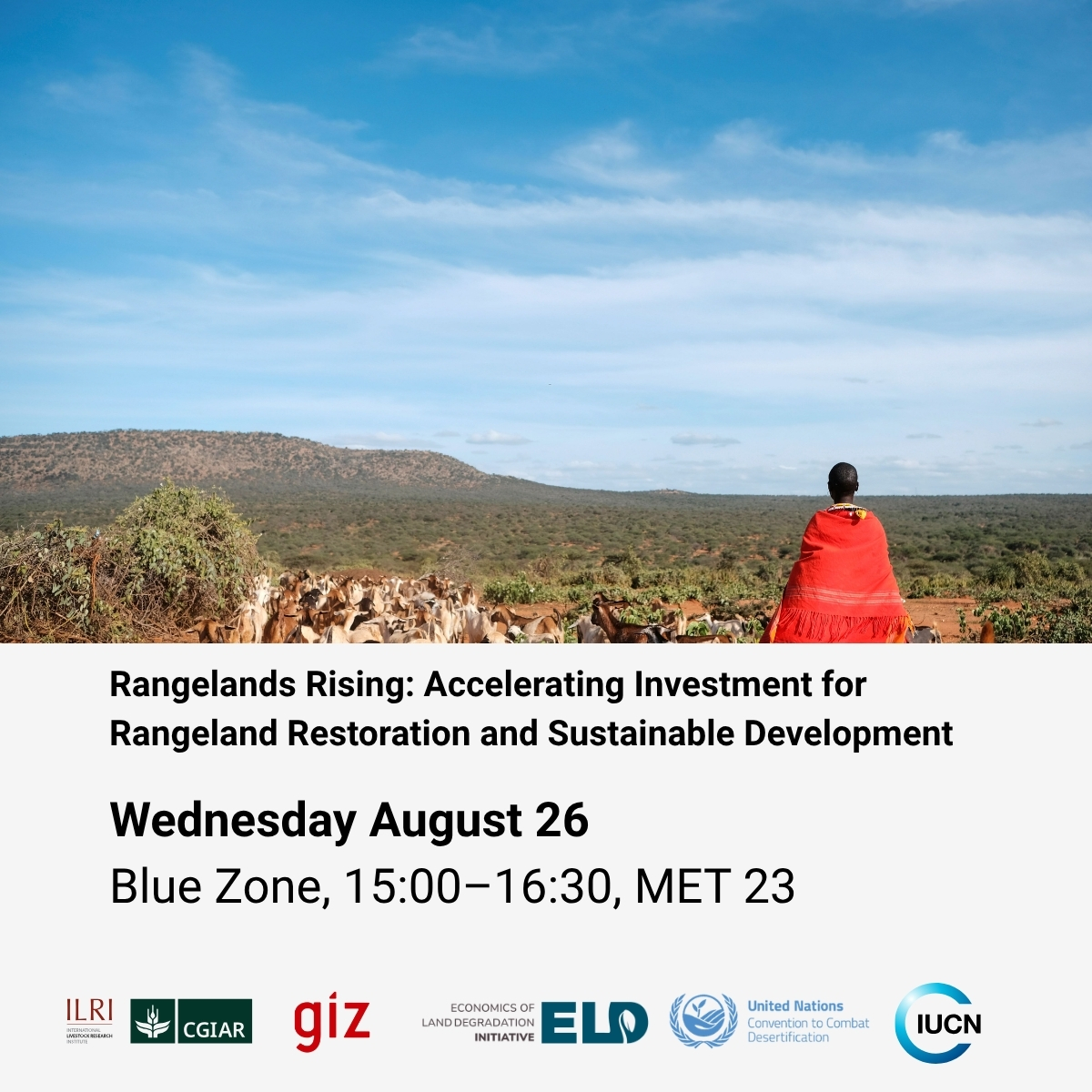
Rangelands Rising: Accelerating Investment for Rangeland Restoration and Sustainable Development
MET 23, Blue Zone
This session will present Rangelands Rising, a new global report by the Economics of Land Degradation Initiative and partners, coordinated by ILRI. Drawing on examples from Mongolia, China, Jordan, Brazil, Ethiopia, and the Sahel, the report shows how enabling policies and blended finance can unlock scalable investment in the dual livestock–nature economy.
It recognizes pastoralists as primary stewards and co-investors and emphasizes secure rights, strong local institutions, gender-responsive approaches, free, prior, and informed consent, and fair benefit-sharing. The discussion will link these findings to the implementation of the UNCCD Rangeland Flagship Initiative and the Land and People Day agenda.
16:30 - 18:00
Advancing UNCCD's Land Tenure Agenda
MET 23, Blue Zone
Objectives:
● Elevate secure and equitable land tenure as a cross-cutting enabling condition for Land Degradation Neutrality, consistent with the Thematic Day's emphasis on people-centered and rights-based land governance
● Take stock of the Future Strategic Framework and set out the range of pathways available for advancing tenure integration going forward, whether through the adopted framework itself, a future GAP revision, indicator development, or a subsequent IWG mandate
● Present formal and voluntary mechanisms as complementary pathways for advancing tenure security commitments, including anticipated government endorsements of the ILTC at COP17
● Discuss the national-level institutional and coordination conditions, including the role of National Focal Points and stakeholder collaboration frameworks, that shape whether tenure commitments are implemented in practice"
ILRI will be represented by Fiona Flintan.
18:00 - 19:30
Enabling Fair and Effective Carbon Solutions for Restoring Rangelands
MET 01, Blue Zone
How can we ensure that emerging carbon finance for rangelands supports ecosystem restoration while delivering fair and tangible benefits to pastoralist communities? There is substantial potential for carbon finance in restoring drylands, but implementation is complex; few suitable methodologies, governance models, and investment approaches exist that suit pastoral systems.
Jason Sircely and Fiona Flintan will be participating along with partners from WHH, Agroecology Coalition, IYRP, WWF, Landscape Alliance, Alliance of Bioversity & CIAT and 4 per 1000 Initiative.
11:00 - 12:00
Empowering Women Farmers and Entrepreneurs across Dryland Agri-food Value Chains: Scaling Proven Approaches from Africa and South Asia
IUCN Pavilion
This is a side event at UNCCD COP17's Women & Gender Day that will showcase proven and emerging approaches to advancing women's economic empowerment across dryland agri-food value chains. Drawing on CGIAR and partner experiences, the session will highlight the ICRISAT-supported women-led self-help group model in Telangana, India, where women are leading thousands of agro-processing enterprises.
Through an interactive discussion among CGIAR centers, government representatives and development partners, the event will explore the success factors, policy enablers and investment pathways needed to scale women-led agribusiness models across Sub-Saharan Africa and South Asia. Birgit Habermann will be a key contributor to the discussion in this side event.
15:00 - 16:30
From margins to mainstream: Recognizing the role of pastoralism in food systems transformation
MET 05, Blue Zone
This session makes the case for investing in pastoralist food systems. It showcases innovations in West African livestock systems, spotlights opportunities for young people and women to contribute, and examines the policy and financing shifts required. It will deliver concrete recommendations from the Africa Food Systems Forum toward the International Year of Rangelands and Pastoralism (IYRP). Abdrahmane Wane from ILRI will be a panelist in this session.
10:30 - 12:00
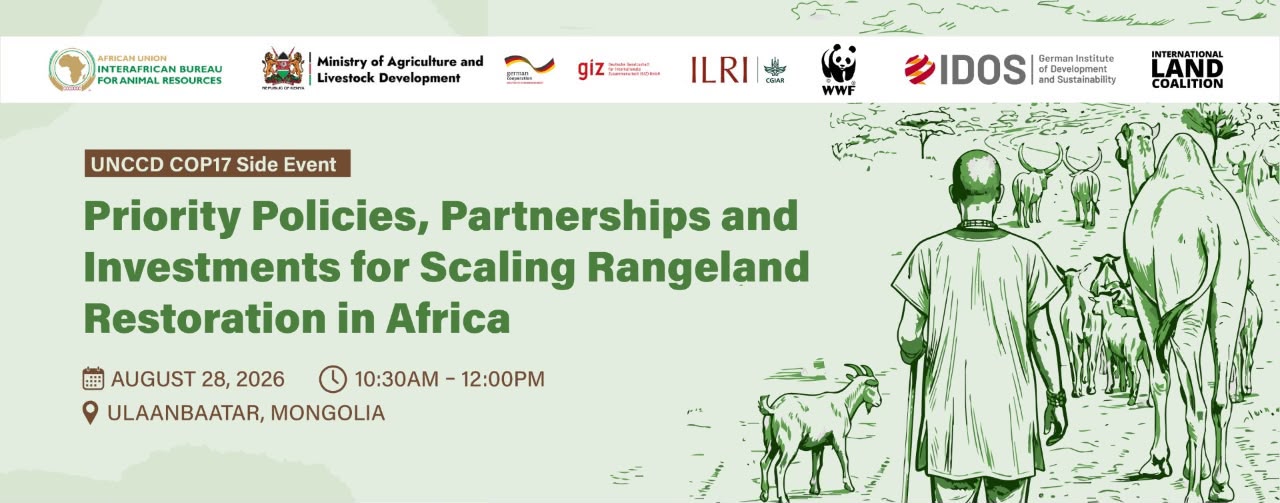
Priority Policies, Partnerships and Investments for Scaling Rangeland Restoration in Africa
MET 04, Blue Zone
This is a side event convened by the Government of Kenya, ILRI, GIZ, WWF, IDOS, ILC and AU-IBAR at UNCCD COP17. The event will reflect on key outcomes and commitments emerging from COP17, including the launch of the UNCCD Rangelands Restoration Flagship Initiative and the Rangelands Rising report.
Abdrahmane Wane, Regional Director for West and Central Africa at ILRI, is a featured speaker in the session "Path Forward: From Commitments to Implementation." He is also leading the discussion on enabling investment to scale rangeland restoration across Africa. Along with Fiona Flintan, they will be contributing expertise on investment priorities, sustainable livestock systems and pathways for mobilizing finance to support restoration, pastoral livelihoods and climate resilience.