
Asian Chicken Genetic Gains (AsCGG): A platform for exploring, testing and delivering improved chickens for enhanced livelihood outcomes in South East Asia
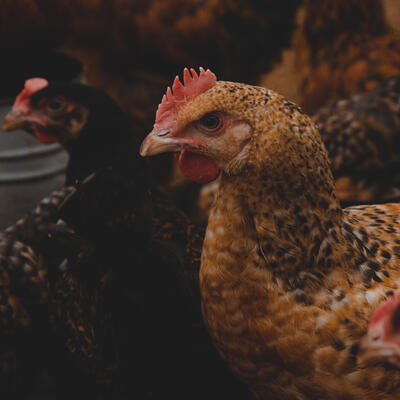
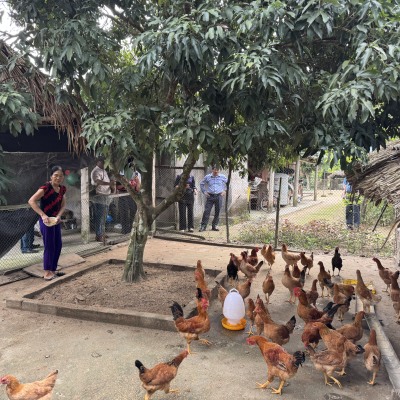
The Asian Chicken Genetic Gains, or AsCGG, project will increase access to locally acceptable, adapted and highly productive chickens and avail new and proven technologies to increase chicken production in Cambodia, Laos and Vietnam.
This four-year partnership is between ILRI and national agricultural research institutes in the three countries, including Cambodia’s National Animal Health and Production Research Institute (NAHPRI) and Vietnam’s National Institute of Animal Sciences (NIAS). It will contribute to many of the agricultural development priorities of these countries, which target, among other goals, boosting the productivity of smallholder chicken farming.
In addition to government research departments, the project envisages working with non-governmental organizations and private chicken input suppliers (in genetics, feed and health) and service providers to develop a roadmap for a longer-term chicken genetic gains programs in each of the three countries.
Building on the success of AsCGG Phase 1 (2022–2025), the new phase will be implemented in Cambodia, Lao PDR, and Vietnam for 2025-2029, scaling proven innovations that enhance productivity, income, and resilience for smallholder poultry farmers. The project is funded by the Australian Centre for International Agricultural Research (ACIAR).
Objectives
The proposed project aims to test and make available high-producing, farmer-preferred genotypes to increase smallholder chicken productivity as a pathway out of poverty in Cambodia, Myanmar and Vietnam. The project will have significant spill over potential across the region through a transformational, farmer-centred approach that enables smallholder access to improved local, tropically adapted and more productive village poultry breeds.
Expected outcomes
- Stakeholders (governments, private sector, other development partners) have evidence-based and culturally relevant recommendations into village poultry breeds that optimise productivity in the agro-ecological and cultural systems of the project countries
- Through public private partnerships, smallholders have access to preferred, healthy and highly producing breeds and associated inputs such as feed and veterinary services
- Demonstrated evidence of the broader impacts of improved poultry production and productivity to smallholder livelihoods, including income and household consumption
- Increased empowerment of women smallholder farmers in the chicken value chain in rural communities
- A functioning multi-country network supporting long-term chicken genetic improvement in Southeast Asia that utilises modern genetic tools to deliver more productive, farmer-preferred village poultry breeds to the region into the future
What's new in phase 2
- Stronger value chains: connecting farmers, researchers & businesses
- Nutrition & gender focus: empowering women and improving family health
- Policy engagement: translating research into regional action
Key activities in Phase 2
- On-farm trials of improved chicken breeds
- Innovation Platforms for co-creation and scaling
- Nutrition and gender-transformative programs
- Capacity building and policy support for sustainable growth
Key partners
- National Animal Health and Production Research Institute (NAHPRI), Cambodia
- National Agriculture and Forestry Research Institute (NAFRI), Lao PDR
- National University of Laos (NUoL), Lao PDR
Vietnam Institute of Animal and Veterinary Sciences (VIAVS)
Related Publications

Genome-wide association study of pre-indicative agronomic traits affecting malt quality in Ethiopian barley (Hordeum vulgare L.) germplasm
Genomics-led leapfrogging as a sustainable scaling alternative to sequential conventional livestock breeding models