Veterinary conference challenges experts to adopt new approaches to livestock development in India
The urgent need to revamp the livestock sector, making it more resilient, inclusive and sustainable was the key message delivered by the International Livestock Research Institute (ILRI) at the Indian Veterinary Extension Forum (IVEF) on 24 June 2025. Ram Deka, the ILRI India country representative, emphasized how emerging technologies such as precision livestock farming, artificial intelligence, robotics, gene editing and digital platforms can revolutionize the sector in the country.
Under the theme, ‘Transforming livestock and rural development: a paradigm shift in teaching, research and extension’, the event brought together 120 experts from India, the USA, the UK, Ghana, Malaysia and Sri Lanka for discussions and lectures on the future of livestock and veterinary extension.
Hosted at the Tamil Nadu Veterinary and Animal Sciences University (TANUVAS), Chennai, the participants discussed key issues in India’s animal production such as:
• emerging trends and transformations in the livestock and poultry sectors;
• evolving extension education strategies and research methodologies;
• inclusive approaches addressing equity, economic and ecological challenges;
• the use of digital tools in extension delivery; and
• forward-looking extension models in a rapidly changing context.
A compendium featuring keynote speeches and lectures was launched and distributed to participants during the event.
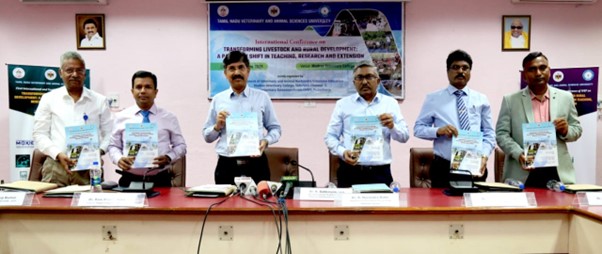
Photo taken during the release of the compendium at the conference (photo credit: ILRI/Vijayalakshmy Kennady).
In his keynote address, Deka highlighted the livestock sector's critical global role, contributing about 40% of agricultural GDP and supporting 1.7 billion livelihoods. However, he warned of increasing vulnerabilities such as climate change, zoonotic diseases, antimicrobial resistance, feed scarcity and workforce attrition, which endanger its sustainability.
‘Today, livestock is not just an economic activity but a cultural cornerstone for millions,’ Deka said. ‘It’s also being viewed as a major contributor to greenhouse gas emissions (9.6% in India) and a source of emerging health threats.’
While citing technological innovation as a key driver of change, he warned that technology alone was not enough. Alongside the adoption of digital tools, the ILRI country representative called for a fundamental shift in how veterinary education, research and extension are approached, urging universities to move beyond textbook learning to localized curricula, interdisciplinary teaching and real-world problem-solving.
‘Students must be treated not just as learners, but as future entrepreneurs and problem-solvers,’ he said.
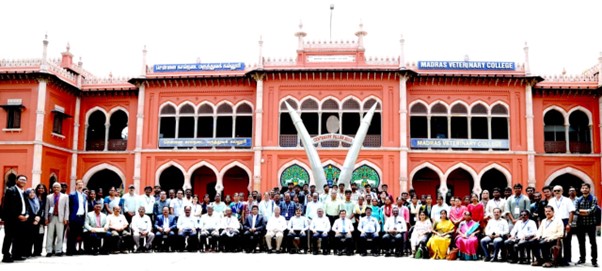
Group photo taken during the conference (photo credit: ILRI/Vijayalakshmy Kennady).
Deka also critiqued the current gap between academic research and on-the-ground impact: ‘Too often, research ends with publications. We must ask how many of our theses actually create change.’
To bridge this divide, he advocated for participatory, outcome-driven and transdisciplinary research that starts with farmer engagement and ends with scalable solutions. He particularly emphasized the transformation of extension services, calling for a shift from top-down, one-way communication to inclusive, tech-enabled and trust-based approaches.
‘Extension isn’t about shouting louder,’ Deka said. ‘It’s about delivering the right message, to the right people, at the right time, in the right way.’ To support this change, he called for the creation of a trained cadre of extension professionals equipped with soft skills, gender sensitivity and communication expertise across platforms; from storytelling to social media. While closing his address, Deka issued a call to action: ‘Let us become the generation that made livestock development a story of hope. Together, we can lead a transformation that benefits people, animals, and the planet.’ This keynote speech set the tone for the conference, and paved the way for dialogue among researchers, academics, policymakers, and veterinary professionals on shaping the future of livestock development in India and beyond.
The event was jointly organized by IVEF Puducherry and the Department of Veterinary and Animal Husbandry Extension Education at Madras Veterinary College, a constituent of TANUVAS. Those in attendance included the government secretary for animal husbandry, the vice chancellor of TANUVAS, and other senior officials from India’s livestock sector.
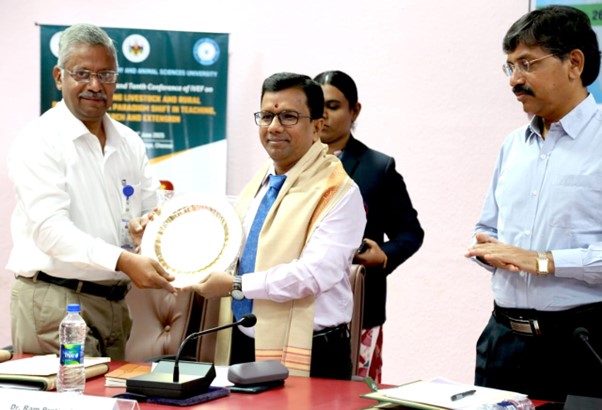
The organizing committee felicitates Deka during the inaugural session of the conference (photo credit: ILRI/Vijayalakshmy Kennady).
(The post was edited by Chi Nguyen, Terry Mwenda and Paul Kariamu, communication officers, ILRI)


Related Publications
Making work for development what works for people: positive deviance for farmer-led adaptation to climate change