Analysis of the Pork Market System in Uganda
Abstract
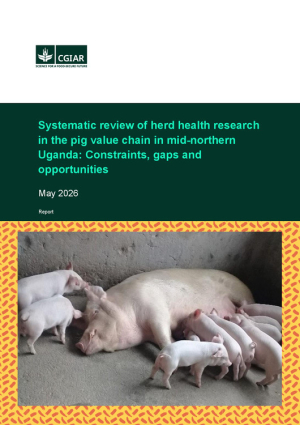
The CGIAR has launched Science Programs to advance its 2030 strategy, including the Sustainable Animal and Aquatic Foods (SAAF) Science Program. SAAF aims to sustainably improve animal and aquatic food systems in 17 countries, focusing on productivity, inclusivity, and environmental sustainability through six integrated research areas: productivity improvement; climate and environment; One Health; market systems, policy solutions and scaling; gender and youth; and digital innovations. In Uganda, SAAF works in Mukono, Masaka, Mpigi, Wakiso, Kitgum, Agago, Pader and Lamwo districts, targeting the pig value chains.
Piggery plays an increasingly important role in Uganda's agriculture, supporting over two million mostly small-scale households who operate backyard farms primarily managed by women. Pigs grow quickly, reproduce often with large litters, and efficiently turn crop waste into high-quality animal protein, making them valuable for both income and food security. They also act as financial assets for farmers. Uganda leads East African countries in pork consumption at 3.4 kg per capita, while beef intake has decreased from 7.7 kg in the 1970s to 6.0 kg in 2020. Despite population growth, overall meat consumption rose slightly to 10 kg per person. Consumer demand for pork is therefore rising, which is also reflected in pig numbers more than doubling from 3.2 million in 2008 to 7.1 million in 2021.
Research efforts led by CGIAR (2012–2024) have supported pig farmers, but smallholders still face challenges in productivity, biosecurity, and climate resilience. Government and private-sector action is needed to strengthen small-scale producers and enterprises across the pork value chain.
To improve the pork value chain in Uganda, SAAF proposes a market systems development approach to influence the behaviour of market actors towards an inclusive and efficient pork market system. This involves enhancing supporting functions (such as information, technology, skills, and infrastructure) and strengthening rules and norms (policies, regulations, and social standards) to address systemic barriers to effective and sustainable performance of market systems for vulnerable pig farmers.
Citation
Rao, E.J.O., Ahumuza, R. and Ouma, E. 2025. Analysis of the Pork Market System in Uganda. Nairobi, Kenya: ILRI.
Authors
Related Publications
Spatial and temporal risk mapping of human and porcine Taenia solium infections in Malawi: a systematic review and geostatistical approach
Microbial Contamination and Associated Risk Factors from Slaughter to Retail: Forward-tracing of meat in the Pork Value Chain in Uganda