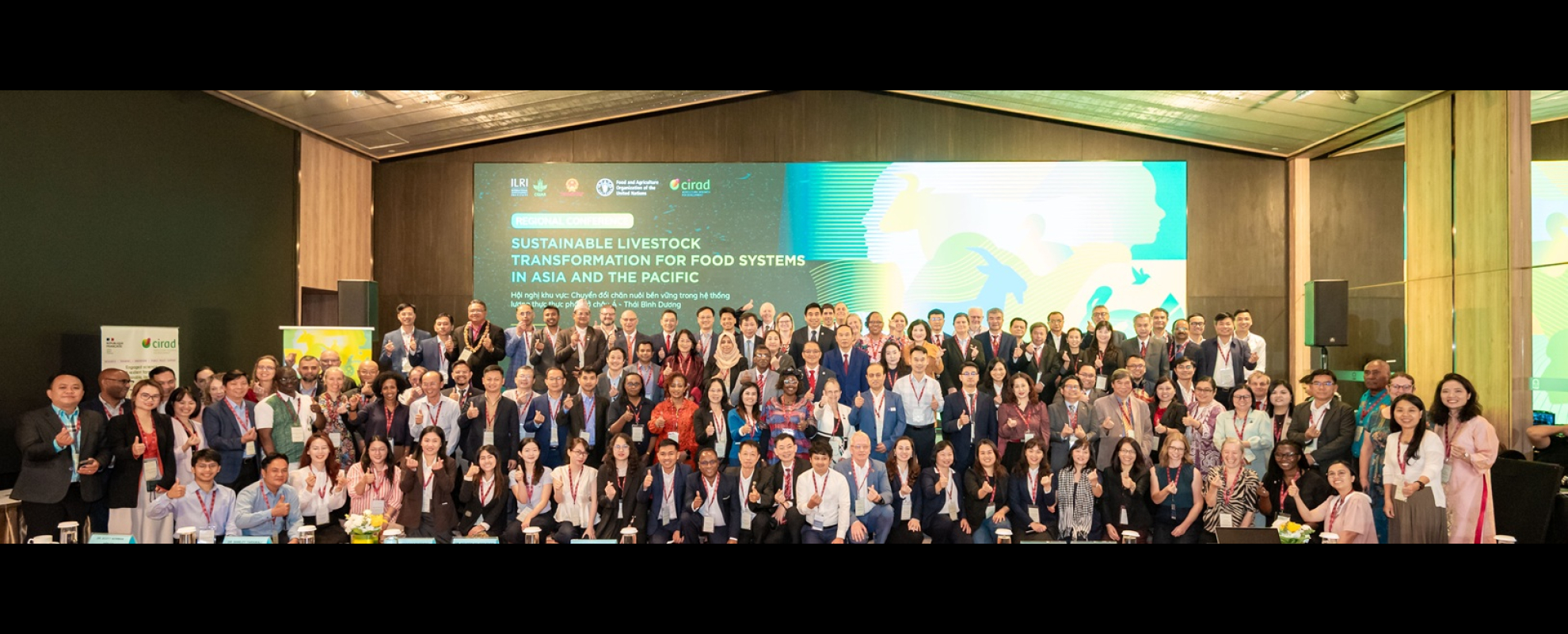
Asia-Pacific countries gather in Hanoi to tackle the future of livestock as food demand, climate pressures and disease risks grow
Hanoi, 24 March 2026 – The Ministry of Agriculture and Environment of Vietnam (MAE), the International Livestock Research Institute (ILRI), the Food and Agriculture Organization of the United Nations (FAO), and the French Agricultural Research Centre for International Development (CIRAD) are co-organizing the regional conference “Sustainable Livestock Transformation in Food Systems in Asia and the Pacific” in Hanoi from 24–26 March 2026.
More than 150 participants—including policymakers, managers, scientists, and researchers from various countries, as well as representatives from embassies, international organizations, research institutes, financial institutions, and the private sector—are attending the conference. Delegates will discuss solutions to promote sustainable livestock development in the context of rising demand for safe and nutritious animal-source foods, alongside the need to expand production and improve farmers’ livelihoods, while the livestock sector faces increasing pressure from climate change, disease outbreaks, environmental degradation, and growing consumer expectations for safe and sustainable food.
The meeting comes at a critical moment for the region. Asia and the Pacific are home to nearly 60 percent of the global population and around 44 percent of the world’s livestock. As populations grow, cities expand and incomes rise, demand for meat, milk and other animal-source foods is increasing.
At the same time, livestock systems in the region are both contributing to and affected by climate change, environmental degradation, zoonotic threats and transboundary animal diseases, alongside growing expectations for safe and sustainably produced food.
Opening the conference, Vice Minister Phùng Đức Tiến of Vietnam’s MAE emphasized the importance of collective action. “Sustainable livestock transformation is not only a requirement for individual countries, but also a shared global responsibility to ensure food and nutrition security and sustainable development. Therefore, increasingly deep international cooperation among countries, international organizations, and key stakeholders is the foundation for promoting innovation, technology transfer, and capacity building for the livestock sector in the region.”
In Asia, the livestock sector supports the livelihoods of hundreds of millions of smallholder farmers, pastoralist communities, and actors along the value chain, while contributing 18–30% of agricultural GDP in many countries. However, the sector is also facing increasing risks. The region accounts for a significant share of global livestock-related greenhouse gas emissions, while the spread of transboundary animal diseases and zoonotic diseases continues to pose challenges to both livestock production and public health.
According to FAO, one in four people in Asia still faces moderate or severe food insecurity, and many households cannot afford diets that include sufficient animal-source foods rich in protein and micronutrients.
In his message to the conference, Mr. Alue Dohong, Assistant Director-General and FAO Regional Representative for Asia and the Pacific, emphasized the need to transform livestock systems to contribute to healthier and more sustainable food systems.
“Livestock systems play a key role in ensuring access to nutritious and affordable diets in Asia and the Pacific. Transforming the sector is essential to strengthening food security while safeguarding the environment and public health,” he said.
Researchers say the solutions already exist. Climate-smart livestock practices, One Health, better feed management, and stronger food safety standards can significantly reduce environmental impacts while improving productivity.
However, scaling these solutions remains a major challenge, often due to fragmented policies, limited coordination between countries and gaps between scientific research, investment and implementation.
Siboniso Moyo, Deputy Director General of ILRI, said the conference aims to bridge those gaps.
"Science and innovation are key to transforming livestock systems. Research on animal health, climate-smart livestock and One Health can help countries improve productivity while managing disease risks and environmental pressures," she said.
Participants will discuss key priority issues, including food security and nutrition, rural livelihoods, animal health and the One Health approach, as well as climate-smart livestock systems.
The conference also provides a platform for countries and partners to share experiences, identify successful models, and strengthen regional collaboration.
François Roger, Regional Director for Continental Southeast Asia at CIRAD, stressed the value of scientific cooperation to solve complex challenges.
“For millions of farmers in the region, livestock is a cornerstone of livelihoods. Research partnerships help develop solutions suited to diverse farming systems, while ensuring that the transformation of the livestock sector contributes to inclusive and sustainable development,” he said.
At the conclusion of the conference, participants are expected to develop recommendations for a regional roadmap toward sustainable livestock transformation, including priorities for research, policy, and investment.
These recommendations are expected to guide future regional collaborative actions, while also contributing to global efforts to transform livestock systems within the broader transformation of food systems.
-30-
Contact:
Ministry of Agriculture and Environment of Vietnam
Department of International Cooperation
Email: mybinhbui@gmail.com
International Livestock Research Institute
Email: c.nguyen@cgiar.org
Food and Agriculture Organization
FAO Regional Office for Asia and the Pacific
Email: le.ly@fao.org
CIRAD
Email: hoailinh.vole@gmail.com
Related Publications
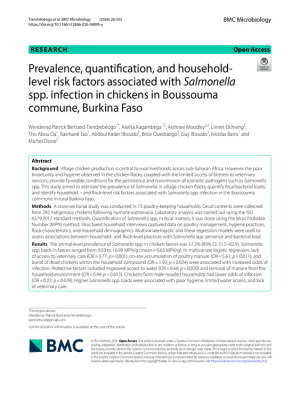
Prevalence, quantification, and household-level risk factors associated with Salmonella spp. infection in chickens in Boussouma commune, Burkina Faso
Impact evaluation of a small ruminant flock health intervention on animal health, welfare, and farmer income in Ethiopia