Options for a just transition for livestock under climate change
Abstract
The livestock sector needs to become environmentally sustainable in ways that ensure fairness and inclusiveness for all, while leaving no one behind: it needs to undergo a just transition. Simultaneously meeting future consumer demand while surviving increasing frequency and severity of climate change hazards, as well as achieving net zero emissions targets and outcomes for water, biodiversity, social resilience and economic development, is a huge ask. Here we discuss what is needed to achieve these multiple outcomes in ways that are socially just. Industrialized livestock production systems will need to invest in adaptation and mitigation measures. In the more extensive systems in which livestock are critical for smallholders’ food security and livelihoods, governments and development partners will need to anticipate the wider range of interventions required to increase resilience in such systems as well as the possibility of facilitating transitions to other livelihood activities. Measures are already available to help livestock farmers in lower-income countries adapt to climate change and reduce emissions. These measures will require finance, policy, technical support, research and development, and monitoring, to incentivize new or modified practices at scale. Both public and private sectors need to move from pledges and commitments to incentives and action through policy targets and disclosure requirements, sustainability-linked finance, and development assistance for innovation.
Citation
Thornton, P., Wollenberg, E., Cramer, L. and Flintan, F. 2025. Options for a just transition for livestock under climate change. Outlook on Agriculture 54(3):222-233.
Authors
Related Publications
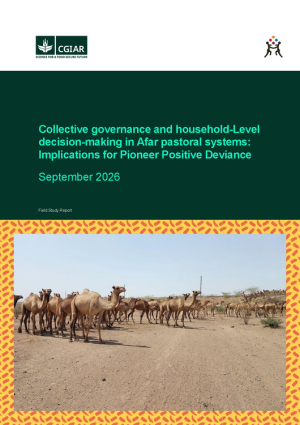
Collective governance and household-Level decision-making in Afar pastoral systems: Implications for Pioneer Positive Deviance