Moving farm-level innovation to scale: Insights from the 8th International Farming System Design Conference
The 8th International Farming System Design Conference (FSD8), held on 25–29 August 2025, at the University of Paris-Saclay, convened global scientists committed to transforming agricultural systems in response to urgent challenges such as climate change, biodiversity loss, food insecurity, and generational renewal. While the need for radical shifts in agrifood systems is widely acknowledged, the central challenge lies not only in scaling innovations but in embedding systems thinking into the very fabric of transformation efforts. This blog post brings together the key insights from sessions that examined the complex barriers and enabling factors shaping farm-level innovation and explores the critical interface between innovation design and scaling in agrifood systems.
Understanding on-farm realities: barriers and levers
A barriers and levers at the farm level session brought together researchers from Asia, Africa, and Europe to examine the real-world constraints shaping farmers' decisions. The session was built around a critical question: why do farmers often not adopt practices that seem to be clearly beneficial?
The answers, from seven diverse presentations:
- In Indonesia, resilience was found to be not just technical but also cultural and spiritual, shaped by subjective values like steadfastness.
- In France, barriers to pesticide reduction were deeply systemic, linked to farm size, existing equipment, and crop choices, not just a lack of will.
- Studies in Tunisia and Rwanda highlighted that limited access to credit, water, and mechanization, as well as high labor demands, were critical constraints.
- Research in Ethiopia underscored the incredible complexity and diversity of smallholder systems. Farmers manage 20 enterprises, and their motivations for redesigning their systems are multifaceted, driven by risk reduction, food security, and income generation. Crucially, these motivations differ between men, women, and youth.
Barriers are never just technical. They are a complex web of economic, social, cultural, and gendered factors. For an innovation to be adoptable, it must be designed with this complex reality in mind.
Designing the solution: frameworks for scaling impact
This session explored the critical interface between innovation design and scaling in agrifood systems. Co-convened by the International Livestock Research Institute (ILRI) and the French National Research Institute for Agriculture, Food and the Environment (INRAE), it brought together six papers that addressed frameworks, tools, and strategies for scaling innovations in ways that are systemic, participatory, and transformative. This session aligned closely with CGIAR’s Scaling for Impact program, which seeks to drive food system transformation through innovation portfolios, co-creation, and responsible scaling.
Jacques-Eric Bergez (INRAE) presented on the OccitANum Living Lab, a regional innovation ecosystem in France that co-designs digital solutions with farmers. He argued, participatory platforms like OccitANum enable systemic change, though challenges remain in data management and stakeholder acculturation.
Shady Hamadeh (American University of Beirut) presented a sustainability framework for local food systems. He introduced the 3x3 sustainability framework, integrating economic, social, and environmental dimensions across internal, upstream, and downstream operations. Embedding research, development and extension within this structure enhances long-term viability and the adoption of innovations in low- and middle-income countries.
Marie-Hélène Jeuffroy (INRAE), in her presentation on methods for systemic design in agrifood systems, analyzed 13 multi-actor design case studies to identify methods that support systemic innovation. She argued that designing systemic innovations in agrifood systems using tailored, system-oriented methods and combining them throughout the process ensures context-specific solutions and strengthens their systemic character, supporting broader scaling and adoption.
Juliette Migairou-Leprince (INRAE), also a convener of the session, presented part of her PhD which is exploring a support program in France that enables coupled design between farmers and public catering services. Scaling was achieved through systemic design of the program to jointly support all actors in innovation and the provision of resources (tools, knowledge, networking activities) aimed at empowering the networks of supported players.
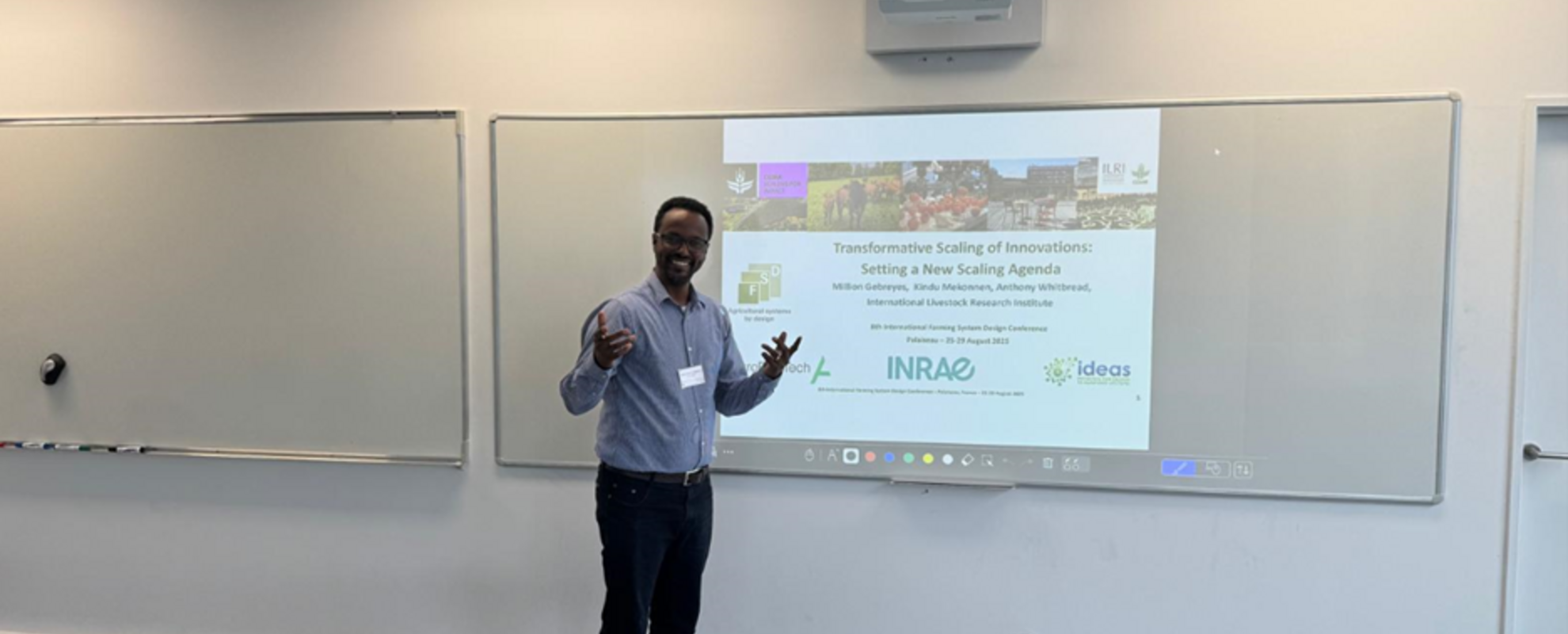
I presented on “Transformative scaling of innovations: setting a new scaling agenda”. Proposing a transformative scaling framework that emphasizes depth (paradigm shifts), scope (systemic change), and speed (urgency, I used a case study from Ethiopia to illustrate the need to embed innovations into national systems and accelerate adoption). These ideas are built on the CGIAR’s Innovation Packaging and Scaling Readiness (IPSR) framework, which adds two critical dimensions:
- Systems orientation: scaling must address structural and institutional barriers to embed innovations into national systems.
- Time sensitivity: urgency is essential, especially in the context of climate action and food system transformation.
As the CGIAR’s ambition is to drive food system transformation through scaling of innovations, the transformation lens ensures that scaling leads to deep, systemic change not just expansion. Scaling requires participatory methods, multi-actor networks, and strategic embedding into national policies to achieve a deep, lasting impact.
The conference made it clear that understanding the farm-level realities and building effective scaling frameworks are not separate tasks. They are two essential parts of the journey towards more sustainable and equitable agrifood systems.
Read more:
Transformative scaling of innovations: setting a new scaling agenda
Understanding farmers’ motivation for mixed farming system redesign: a case from Ethiopia
You may also like
ILRI News
Turning cassava waste into opportunity: Scaling high quality cassava peels for people, profit and the planet

ILRI News
Conservation agriculture techniques are improving agricultural productivity in Zimbabwe’s drylands



Related Publications
Scaling feed and forage innovations through improved seed multiplication and commercialization in Ethiopia
- Mekonnen, Kindu
Market opportunities and business models for scaling feed and forage innovations in Ethiopia’s mixed farming systems
- Gebreyes, Millon