Co-creation of a business model for delivery of herd health products and services to pig farmers
Abstract
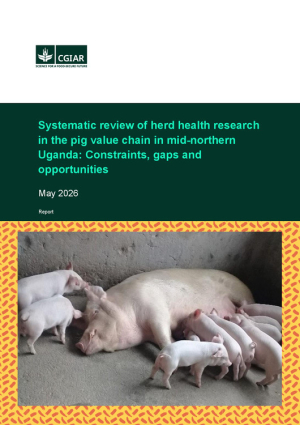
In Uganda, the pig sector is the fastest growing livestock subsector contributing to household incomes, food security and employment. However, the subsector is constrained by various technical, institutional and structural challenges across the entire value chain. Under the Livestock Collaborative Research Program (CRP), the International Livestock Research Institute (ILRI) conducted studies on the pig value chain in Uganda to identify key herd health challenges and constraints. Findings from these studies reveal the pig sector is characterized by informal networks, weak linkages and lack of coordination between value chain actors with limited contractual arrangements (Ouma et al. 2014, Tatangwire, 2014, Twine and Njehu, 2020). Other studies reported that the veterinary sector is massively under-resourced, with many inadequately trained para-veterinarians (mainly private) fulfilling an important role in the provision of veterinary services (Arvidsson et al. 2022, Ilukor et al. 2020, Okello et al. 2020). It was reported that staff absenteeism, poor funding and limited infrastructure were key governance challenges facing veterinary services in Uganda (Ilukor et al. 2015, Bugeza et al. 2017, Dione et al. 2014). These studies revealed that the key herd health constraints were high disease burden (African swine fever [ASF], parasites, etc.), knowledge and information gaps among farmers on health, biosecurity and welfare; poor quality of veterinary inputs and support services – drugs, vaccines, feeds and breeding. The result is that veterinary services in Uganda lack the capacity to provide quality veterinary inputs and services to pig farmers.
To overcome these constraints, ILRI working with national partners co-designed and tested (under SAPLING Initiative) an integrated technology package of interventions to improve pig herd health, productivity and welfare, as well as knowledge and practices of farmers in pig production. In a ‘before-and-after’, ‘with-and-without’ factorial design, the integrated technology innovations (herd health, feeds and forages, and breeding) were implemented and evaluated in Wakiso and Mukono districts for their impact on pig productivity, health, welfare, knowledge and practices of pig farmers. Following its implementation, significant improvements in productivity, knowledge and practices of farmers have been observed.
Under the new Sustainable Animal Aquatic Foods (SAAFs) science program, a key output is the development of a business model for the delivery of a context-specific herd heath package (including vaccination). To this end, we co-designed a business model for integrated delivery systems (health, feed, genetics) based on a market systems development approach. A market systems development (MSD) approach aims to facilitate or change the way markets operate to improve the participation of vulnerable people and the performance of a market system. For the Ugandan context, pig farmers have limited access to critical production inputs and services needed to effectively engage in profitable production. As a result, the productivity of their pigs remains low, which exposes farmers to unfavorable market dynamics and shocks such as disease outbreaks and price fluctuations.
Given a series of herd health constraints highlighted in the above studies, an MSD approach is a viable tool that can be used to improve and sustain the delivery of herd health inputs and services to farmers as it strengthens the functioning of the market system (MEDA and CARE, 2020). To develop an innovation package that addresses these bottlenecks, a one-day MSD workshop was held on 26th November 2025 at Protea Skyz Hotel Kampala, to co-create a business model with a view to enhance the delivery of herd health inputs and services to pig farmers. The co-created model will be tested in Masaka and Mukono districts.
Citation
Oba, P., Ouma, E., Rao, E.J.O., Businge, M. and Dione, M. 2025. Co-creation of a business model for delivery of herd health products and services to pig farmers. Nairobi, Kenya: ILRI.
Authors
Related Publications
Spatial and temporal risk mapping of human and porcine Taenia solium infections in Malawi: a systematic review and geostatistical approach
Microbial Contamination and Associated Risk Factors from Slaughter to Retail: Forward-tracing of meat in the Pork Value Chain in Uganda