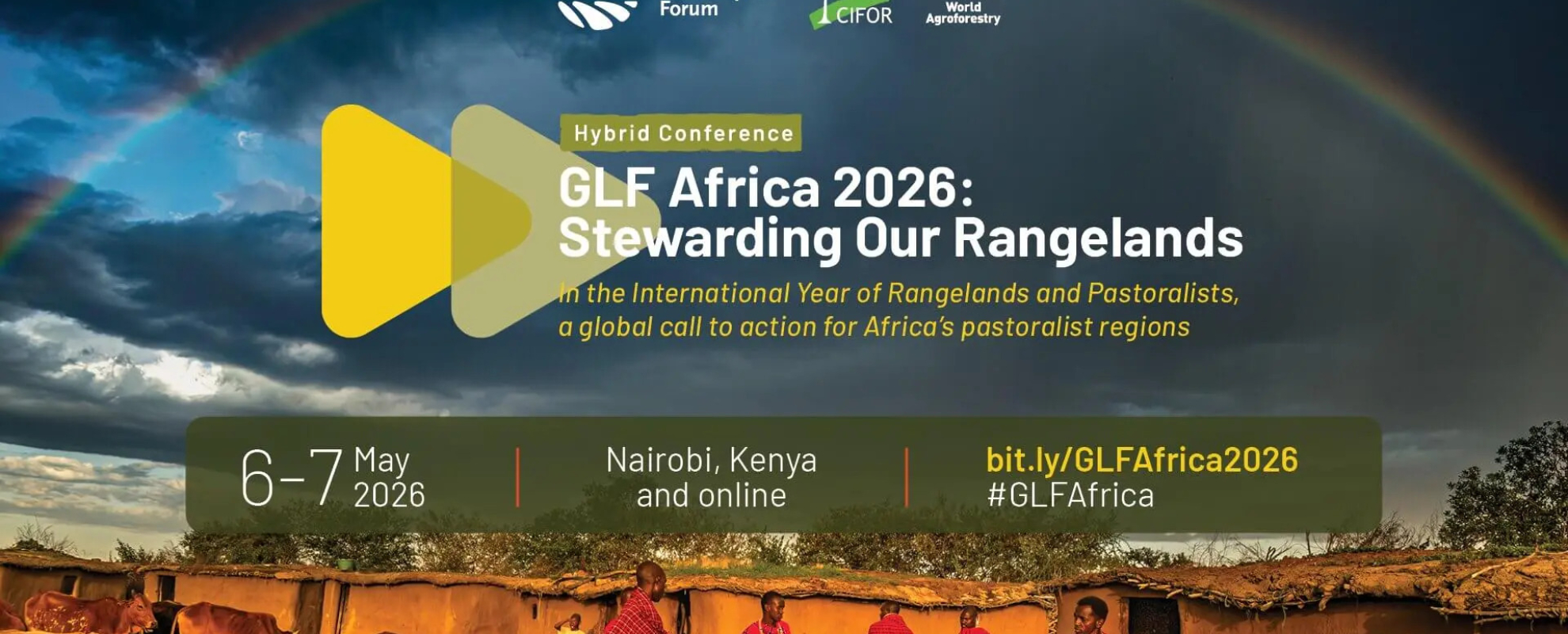
Global Landscape Forum Africa 2026: Stewarding Our Rangelands
GLF Africa 2026: Stewarding Our Rangelands brings together policymakers, researchers, practitioners and pastoral communities to spotlight one of the continent’s most vital yet under-recognized ecosystems. Rangelands underpin livelihoods, biodiversity, and climate resilience across Africa, and this convening will focus on actionable pathways to restore, manage and sustainably scale their potential. As a global leader in livestock research for development, the International Livestock Research Institute (ILRI) plays a central role in advancing evidence, innovation and partnerships that connect science to practice. Through its deep engagement in rangeland systems, pastoral livelihoods and climate-smart livestock solutions, ILRI anchors the event’s ambition to translate knowledge into impact at scale.
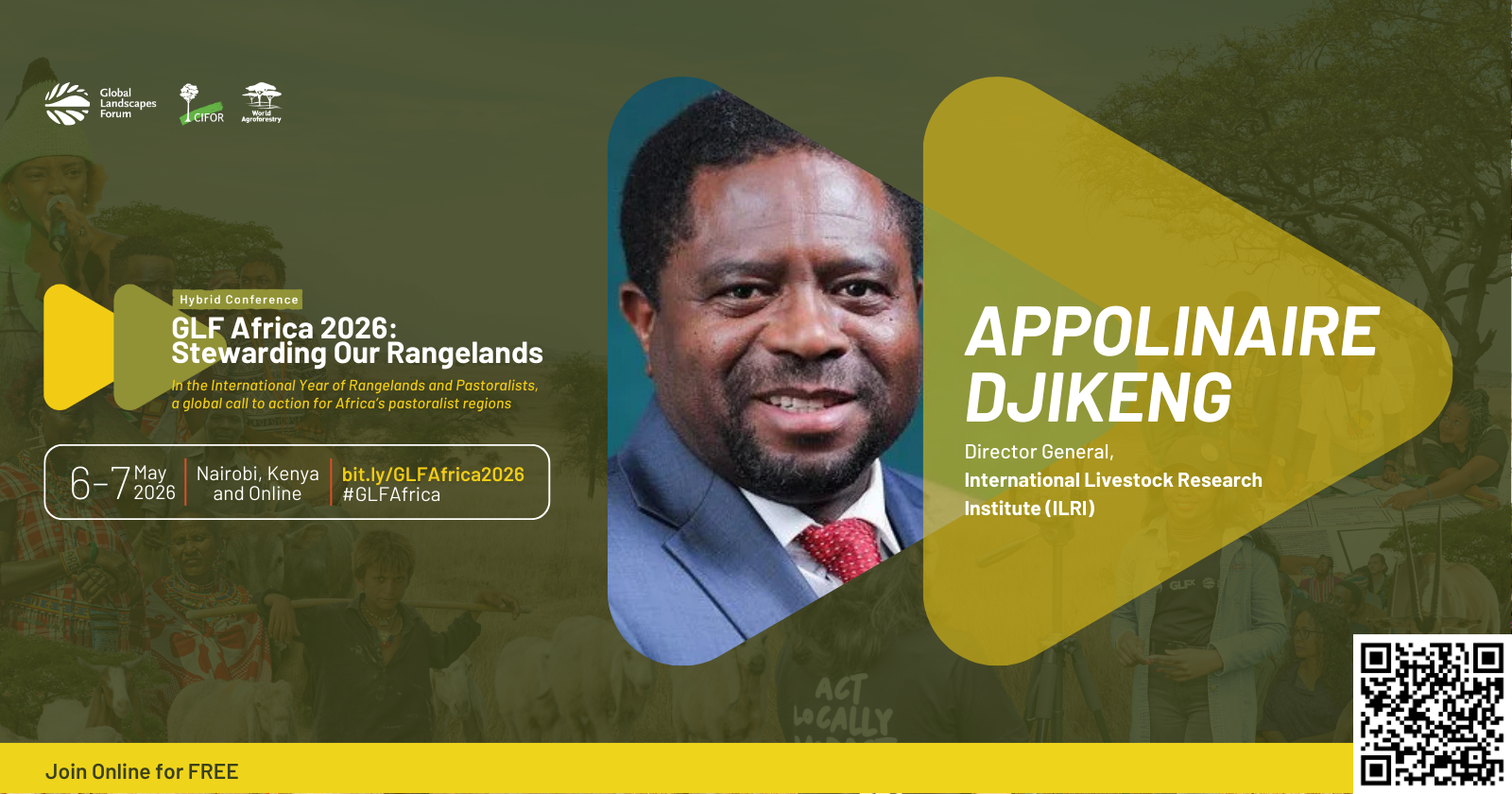
Prof. Appolinaire Djikeng will be speaking at the Closing plenary: Governing a common of 'GLF Africa 2026: Stewarding Our Rangelands' that aims to bring together over 8,000 global leaders to champion Africa’s rangelands, amplify pastoralist voices and drive innovative solutions for a resilient, community-led future
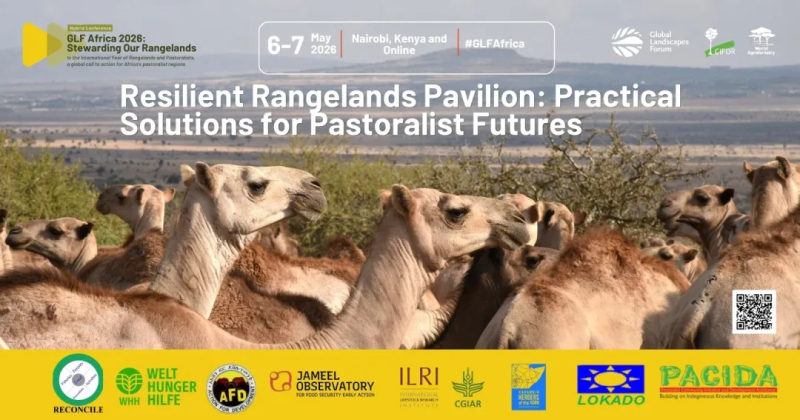
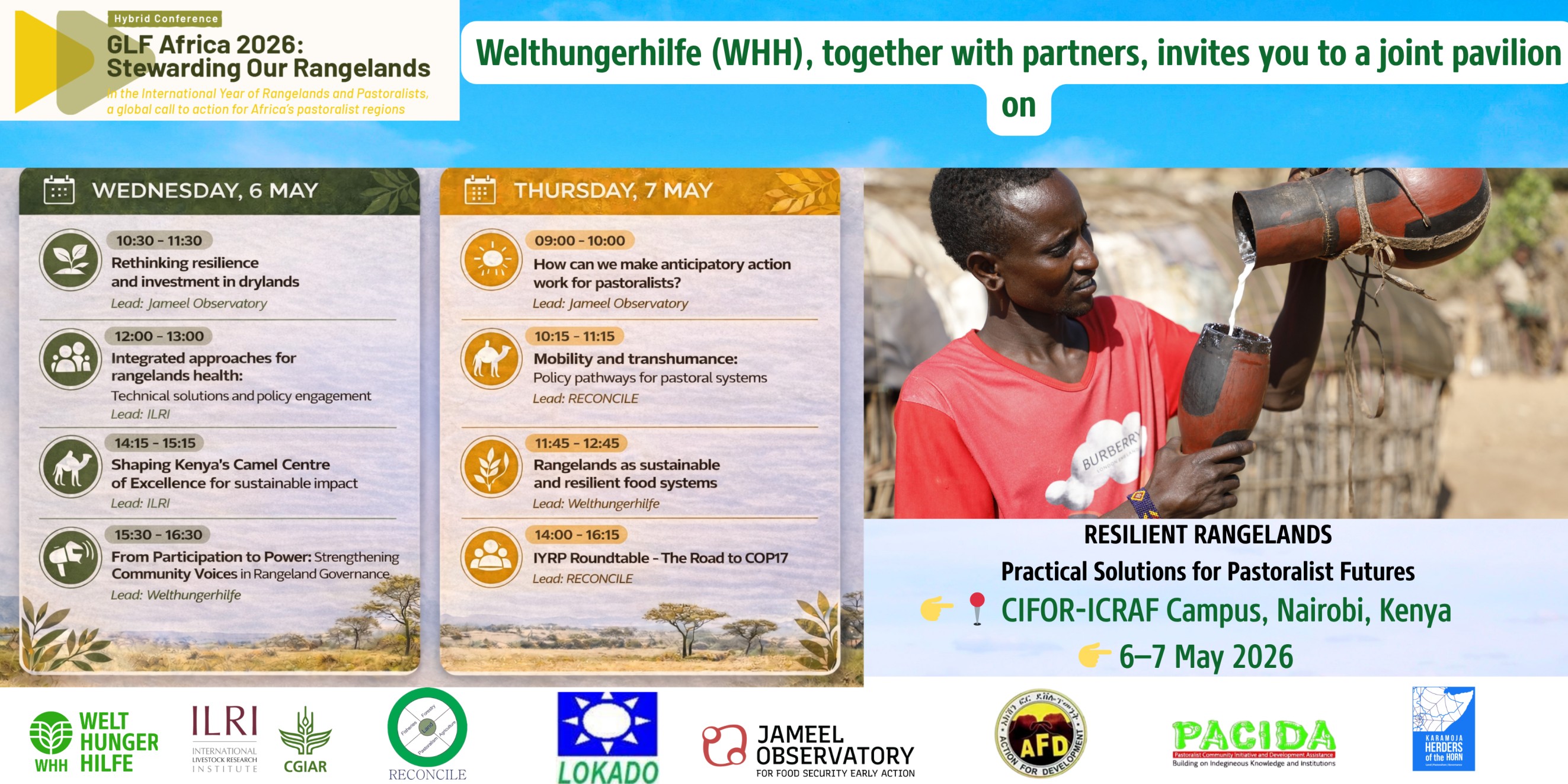
Welthungerhilfe, Jameel Observatory, ILRI and partners invite you to the Resilient Rangelands Pavilion
The pavilion brings together a thought-provoking and pragmatic set of contributions on practical, locally led, scalable and investment-ready pathways towards more resilient rangelands and more prosperous livelihoods for pastoralists. Drawing from the wider Horn of Africa, speakers will link rangeland ecology, pastoral livelihoods, food systems, markets, and governance systems into a coherent resilience approach.
More information: GLF Africa 2026: Resilient Rangelands Pavilion
Resilient Rangelands Pavilion
The joint pavilion sessions aim to strengthen collaboration among research, policy, private-sector, and pastoral actors, bridging global discourse with local realities and contributing to the International Year of Rangelands and Pastoralists.
10:30 - 11:30
Rethinking resilience and investment in drylands
@ Resilient Rangelands Pavilion
Resilience programming is widespread across East Africa’s drylands, aiming to promote holistic system-wide capacities to withstand shocks and stresses in the face of competing land uses such as carbon credits, industrialization, urbanization, extractives and conservation. This session will explore whether resilience has been truly enhanced, what its future is in a world of aid cuts and shifting priorities, and what roles ‘everyday’ locally-led resilience and local forms of solidarity and social protection can play.
Session hosts:
12:00 - 13:00
Healthy rangelands, healthy livestock, healthy people – Integrating rangelands in One Health
@ Resilient Rangelands Pavilion
HEAL (One Health Units for Humans, Environment, Animals and Livelihoods), a project funded by the Swiss Development Cooperation and operating in Ethiopia, Kenya and Somalia, aims to enhance the well-being and resilience of pastoralist communities by practically implementing a One Health approach through integrated service units. This session will share experiences and lessons learned from the first phase of implementation, particularly in terms of integrating the environment and rangelands into the One Health approach, and invite input and feedback on the project’s results to date, together with advice for improvement.
Session hosts:

14:15 - 15:15
Shaping Kenya’s Camel Centre of Excellence for sustainable impact
@ Resilient Rangelands Pavilion
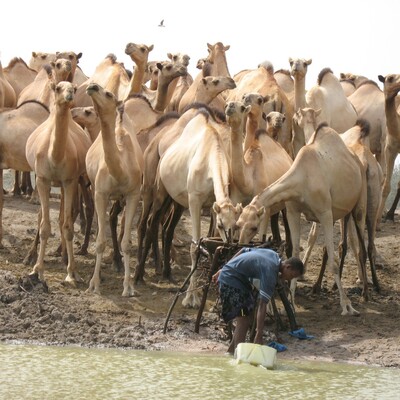
Following the 2024 Pastoralist Leadership Summit, the Government of Kenya directed the establishment of a Camel Centre of Excellence to coordinate engagement across government, research, NGOs, the private sector, camel breeders and international partners. This decision signals growing recognition of camels as central to resilient livelihoods, food systems and climate adaptation in arid and semi-arid regions.
This session will convene key stakeholders to share progress, identify challenges and explore collaborative pathways to operationalize the Centre. Discussions aim to surface key considerations, opportunities and challenges to inform the Centre’s development and ensure it is relevant, collaborative and grounded in the needs of pastoral systems.
Session hosts:

15:30 - 16:30
Learning from pastoralism to foster resilience of food systems
@ Conference hall
This session will explore how pastoral systems can inform the transformation of resilient food systems in the face of climate variability. Drawing on evidence from a GIZ background paper, it will highlight pastoralism as a sophisticated, adaptive system grounded in mobility, Indigenous knowledge and flexible resource governance.
Government, research and practitioner representatives will discuss how enabling policies and co-management approaches can strengthen rangeland resilience, support livelihoods, and reduce conflict. The session aims to shift narratives around pastoralism, align with the International Year of Rangelands and Pastoralists, and advance policy dialogue towards UNCCD COP17.
Session host:
15:30 - 16:30
From participation to Power: Local actors’ voices in rangeland governance
@ Resilient Rangelands Pavilion
Rangelands hold significant ecological and socio-economic value, making their governance a critical concern. As primary stewards, communities play a central role, yet their influence in decision-making processes often remains uneven and not fully understood. This session will examine the current positioning of community voices in rangeland governance, with a focus on how power and decision-making are structured and exercised, exploring key themes including localization and its practical implications, access to and control over funding, the role of indigenous knowledge systems, and issues of accountability.
Session host:
09:00 - 10:00
How can we make anticipatory action work for pastoralists?
@ Resilient Rangelands Pavilion
Built around forecasts, early warning systems and pre-agreed triggers, ‘anticipatory action’ offers the prospect of acting early to reduce the impact of hazards. Yet in pastoralist regions across the Greater Horn of Africa, questions remain about what anticipatory action really is, what it does and who it serves. This session will open up a critical conversation around the future of anticipatory action in pastoralist contexts. Rather than taking its value as given, we ask: what does it mean to ‘make anticipatory action work’ for pastoralists, and who gets to define what ‘working’ looks like?
Session hosts:

11:45 - 12:45
Drylands of tomorrow – Narratives and know-how from an abundant world
@ Watering Point Pavilion
Drylands and rangelands are often seen as dry, empty, and unproductive, with pastoralists perceived as poor and vulnerable. However, this view overlooks the strengths of local communities. This session examines how investments in the Horn of Africa’s drylands, based on an ‘abundance narrative,' leverage pastoralists' capacities, innovation, and supportive policies.
Session hosts:

11:45 - 12:45
Making pastoralism work for sustainable and resilient food systems in rangelands
@ Resilient Rangelands Pavilion
This session explores how livestock systems can support sustainable and resilient food systems, livelihoods, healthy diets, and rangeland health. It shifts the view of pastoralism from vulnerable land use to adaptive food systems vital for nutrition, markets, climate resilience, and biodiversity in drylands. Pastoralists are seen as solution-holders and rangeland guardians, not just beneficiaries. Panelists will discuss how a holistic systems approach can create multiple benefits for livelihoods, nutrition, climate, and biodiversity.
Session hosts:

14:00 - 16:15
The International Year of Rangelands and Pastoralists on the road to UNCCD COP17
@ Resilient Rangelands Pavilion
This session will define the International Year of Rangelands and Pastoralists as a milestone on the road to UNCCD COP17. It highlights rangelands' importance in supporting livelihoods, biodiversity, and climate resilience in drylands. Participants will discuss policy priorities, share best practices, and identify investment opportunities for sustainable management. The session will also stress the need to amplify pastoralist voices, integrate Indigenous knowledge, and align commitments across levels. Its goal is to foster inclusive, evidence-based actions to influence COP17 outcomes and beyond.
Session hosts:

Closed workshop
Held as part of GLF Africa 2026, this closed workshop will bring together senior stakeholders shaping the future of land, restoration and pastoral economies on the continent. The conversation will focus on what is needed to better align finance with local stewardship in Africa, including:
• barriers that continue to keep strong projects and suitable finance apart
• features and support required to make a platform like Rio Changemakers useful in practice
• kinds of pathways, partnerships and pipelines needed to move from project visibility to deal flow
Fiona Flintan will be participating in this workshop.
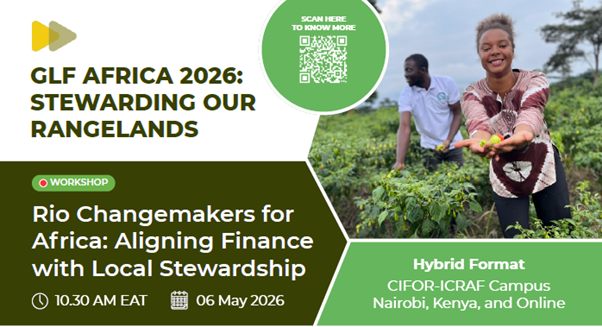
10:30
Rio Changemakers for Africa: Aligning Finance with Local Stewardship
This workshop will gather senior stakeholders shaping Africa's land, restoration, and pastoral economies. As finance becomes key to building resilient landscapes, it will focus on how capital reaches African projects and why it often doesn't. Conceptualized by the Global Landscapes Forum and the Government of Luxembourg, Rio Changemakers is an AI-powered, science-based marketplace that connects investors with local climate and biodiversity initiatives. As it enters a crucial design phase, this workshop will test its relevance to African market realities, including deal sizes, tenure systems, risk perceptions, pipeline gaps, and project challenges.
Unlocking finance, investments and livelihoods in rangeland and pastoralist economies
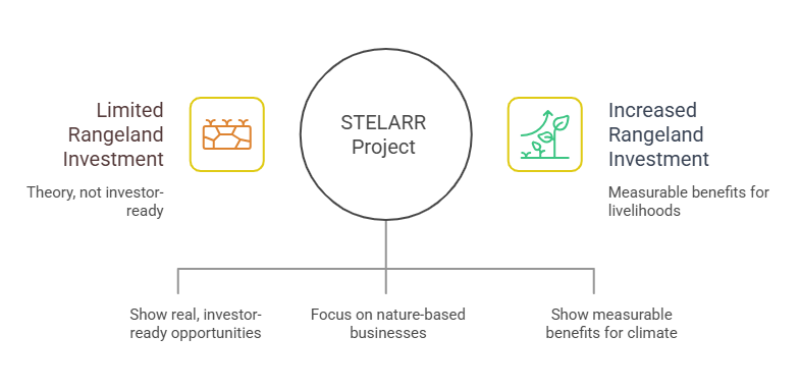
On the closing day of GLF Africa 2026, there is a high-level plenary on Unlocking finance, investments and livelihoods in rangeland and pastoralist economies that will highlight a set of flagship investment cases developed by the International Livestock Research Institute through the STELARR project, with support from the Global Environment Facility and the International Union for Conservation of Nature (IUCN). These cases go beyond theory to show real, investor-ready opportunities in sustainable livestock systems, nature-based businesses, and climate-friendly value chains. They demonstrate how rangelands can deliver measurable benefits for livelihoods, biodiversity, and climate resilience.
Framed as a link between pastoral systems and financial markets, the session will break down how these investment cases are designed to tackle long-standing challenges, such as communal land rights, mobility, and perceived risk, while promoting stewardship, fairness, and long-term ecological benefits. By showcasing these models, the plenary aims to spark new partnerships and funding streams that view pastoralists not just as beneficiaries but as co-investors in resilient, regenerative rangeland economies.
Session hosts:
To join the session online, please go to this link.