For the first time, methane is measured directly from free-grazing pastoral cattle—improving how emissions are understood
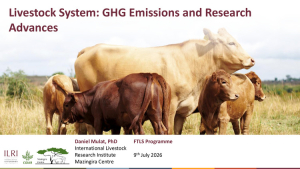
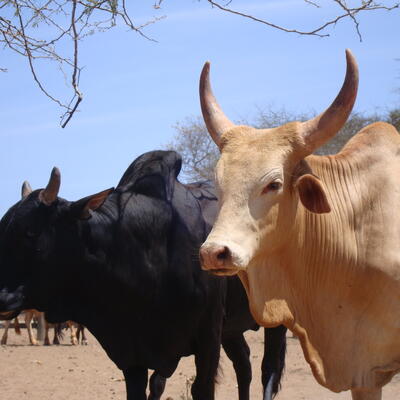
In a major advance for livestock and climate science in the region, scientists at ILRI's Mazingira Centre have directly measured enteric methane emissions and feed intake of free-grazing pastoral cattle in East Africa.
This tracer gas-based technique has long been used in countries like New Zealand, Australia, Latin America, the USA and South Africa, but until now had not been successfully adapted to East Africa's rangelands.
“We adapted internationally recognized methods to measure enteric methane emissions and feed intake from free-grazing livestock under field conditions," said Daniel Girma Mulat, laboratory manager and lead scientist of the project.
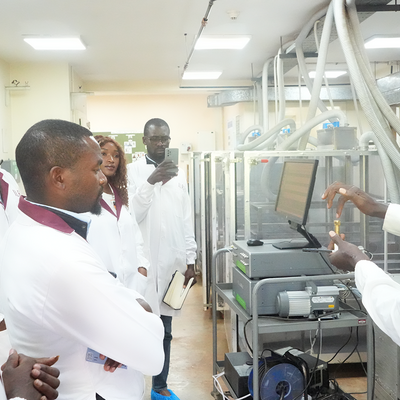
As a regional hub for livestock and environmental measurement, Mazingira Centre trains and supports partners across sub-Saharan Africa. This work strengthens local capacity to quantify greenhouse gas (GHG) emissions and evaluate climate-smart innovations for pastoral systems.
“It allows us to validate modeled emissions, improve feed-efficiency (animal production per unit of feed intake), and test mitigation options suited to grazing animals,” said Edward H. Cabezas-Garcia, postdoctoral researcher at ILRI's Mazingira Centre.
Capturing a cattle's breath
When cattle graze, microbes in the rumen (stomach) break down feed and generate enteric methane as a by-product, which is primarily exhaled through the cattle's breath. Enteric methane production uses up about 6–12% of the energy in the animal’s feed, meaning this energy is lost instead of helping the animal grow or produce milk. Methane is also a potent GHG contributing to global warming. So mitigating enteric methane emissions could increase animal productivity and benefit the climate.
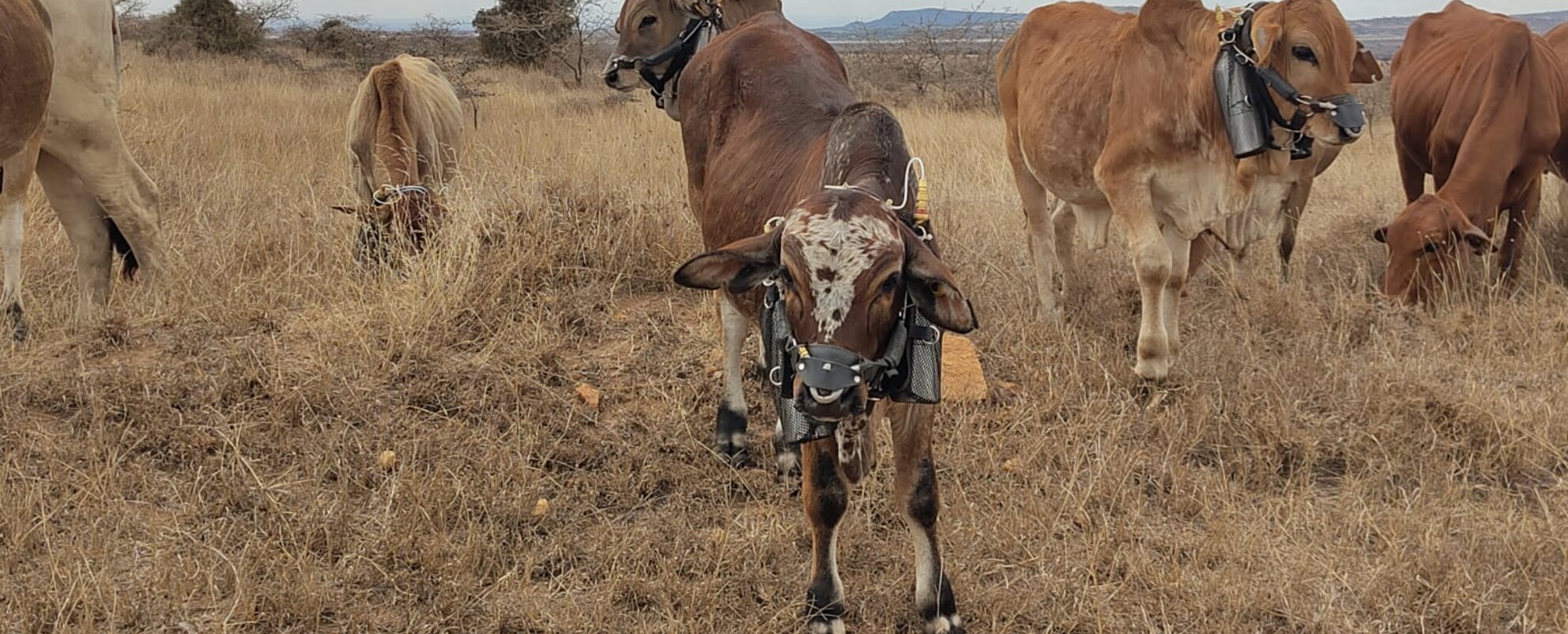
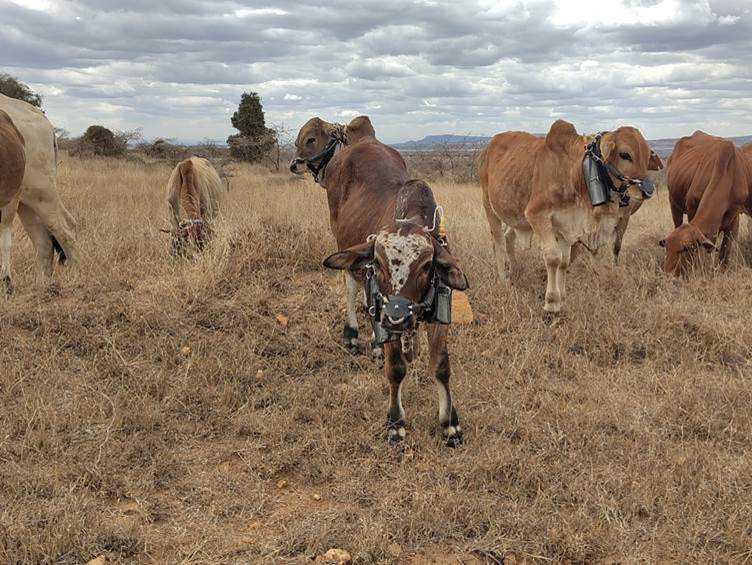
To measure enteric methane emissions from grazing cattle, scientists fitted animals with a light harness that carried a lightweight breath collection canister. This setup captured exhaled breath while the animal moved naturally across the rangelands.
Measuring what cattle actually eat
To understand the full picture, researchers also measured feed intake using a harmless marker (titanium dioxide) added to the animal's feed. The marker passes through the digestive system unchanged, and its ratio to indigestible plant material in faeces provides a reliable measure of feed intake.
Linking feed intake, methane emissions, and body weight gain offers an assessment of productivity and sustainability. These measurements allow scientists to calculate methane emitted per unit of feed, per kilogram of animal weight gain, and overall feed efficiency under grazing conditions.
Why this data is critical for Africa
“Direct field data like this are vital to strengthen GHG emission estimates in livestock,” said Claudia Arndt, team leader of Mazingira Centre and co-lead of the project. “They help refine emission factors, validate mathematical models to estimate emissions, and design mitigation strategies that work for grazing cattle.”
Currently, many African countries rely on Intergovernmental Panel for Climate Change (IPCC) methodologies developed using data from other environments and breeds. Collecting Africa-specific field data is therefore essential for accurately representing the continent’s livestock systems and for identifying the most effective mitigation options.
Because of this collecting Africa-specific data is essential for ensuring the continent's livestock systems are accurately represented in global GHG assessments, and for determining which mitigation strategies will work best.
The methane emissions generated from this direct measurement will also help validate ILRI's earlier work on Tier 2 emission factors (Why livestock emission estimates might vary: The Tier 2 model effect), which relied on modelling and production data, and will support the development of local emission factors.
Next steps
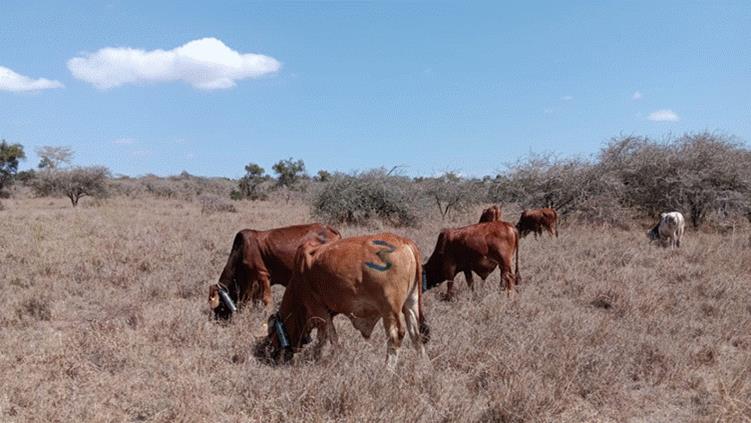
The methodology has now been used to measure animal productivity and methane emissions in Boran cattle at Kapiti, together with the rumen bacteria and methanogen communities that influence feed digestibility and methane output, in partnership with BiomEdit. The methodology also be expanded to measure methane in small ruminants, and evaluate tropical forage legumes that may help reduce enteric methane emissions in grazing cattle under the Low Methane Forage Project.
“By applying this method, we can test mitigation strategies under real African conditions and provide countries with better data for their livestock GHG inventories,” Arndt concluded. “This will accelerate progress toward more productive, low-emission livestock systems.”
This pioneering work demonstrates that advanced methane-measurement techniques can be successfully deployed under African field conditions. With targeted investment, such studies can be extended to additional sites, livestock species, and mitigation strategies, creating a regional evidence base that supports national GHG inventories, informs policy, and guides climate-smart livestock interventions and investments.
Partners interested in strengthening Africa’s livestock measurement, reporting and verification (MRV) systems are invited to engage with Mazingira in accelerating this next phase of impact.
Technical information
Acknowledgements
The work is being carried out by scientists from ILRI’s Mazingira Centre, in collaboration with BiomEdit, Inc. (https://biomedit.com/), in conjunction with the Low Methane Forage (LMF) Project (https://alliancebioversityciat.org/projects/low-methane-forages-lmf).
The work is being implemented at ILRI’s Kapiti Research Station. Vibeke Lind (Mazingira and NIBIO) also provided technical input to adapt the method for use in African field conditions. This study would not have been possible without the technical and field support of Stanley Mwangi, Rodgers Rogito, Elly Kibira, Paul Mutuo, Abasi Kigozi, Moses Ogeto, Kiprotich Linus, and Sospeter Wambugu of ILRI.
Funders
This pioneering work is supported by:
- Rumen microbiome atlas of cattle from Sub-Saharan Africa and association with methane emissions and feed efficiency, Sub granted to ILRI from BiomEdit, Inc., funded by the Gates Foundation.
- The Low Methane Forage (LMF) Project, funded by the Bezos Earth Fund and the Gates Foundation.
- Additional support for this research was provided through CGIAR Science Program on Climate Action, Multifunctional Landscapes, Sustainable Animal and Aquatic Foods and is supported by contributors to the CGIAR Trust Fund. CGIAR is a global research partnership for a food-secure future dedicated to transforming food, land, and water systems in a climate crisis.
- The research reported here was partially supported by a gift made to ILRI by the Ballmer Group that invests in Livestock and Climate research and development in Africa.
Related Publications
Estimating carbon footprints and economic trade-offs in Mongolia's cashmere value chain: An integrated system dynamics approach