Sustainable manure management in Uganda requires an enabling policy and legal framework: a call to action!
Challenges of improper manure management
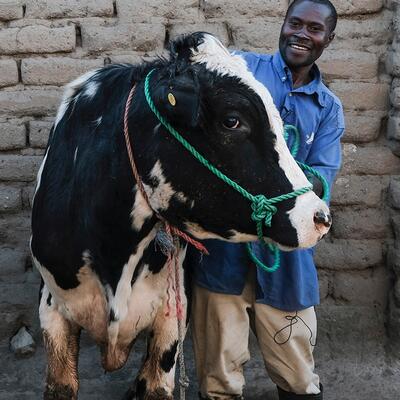
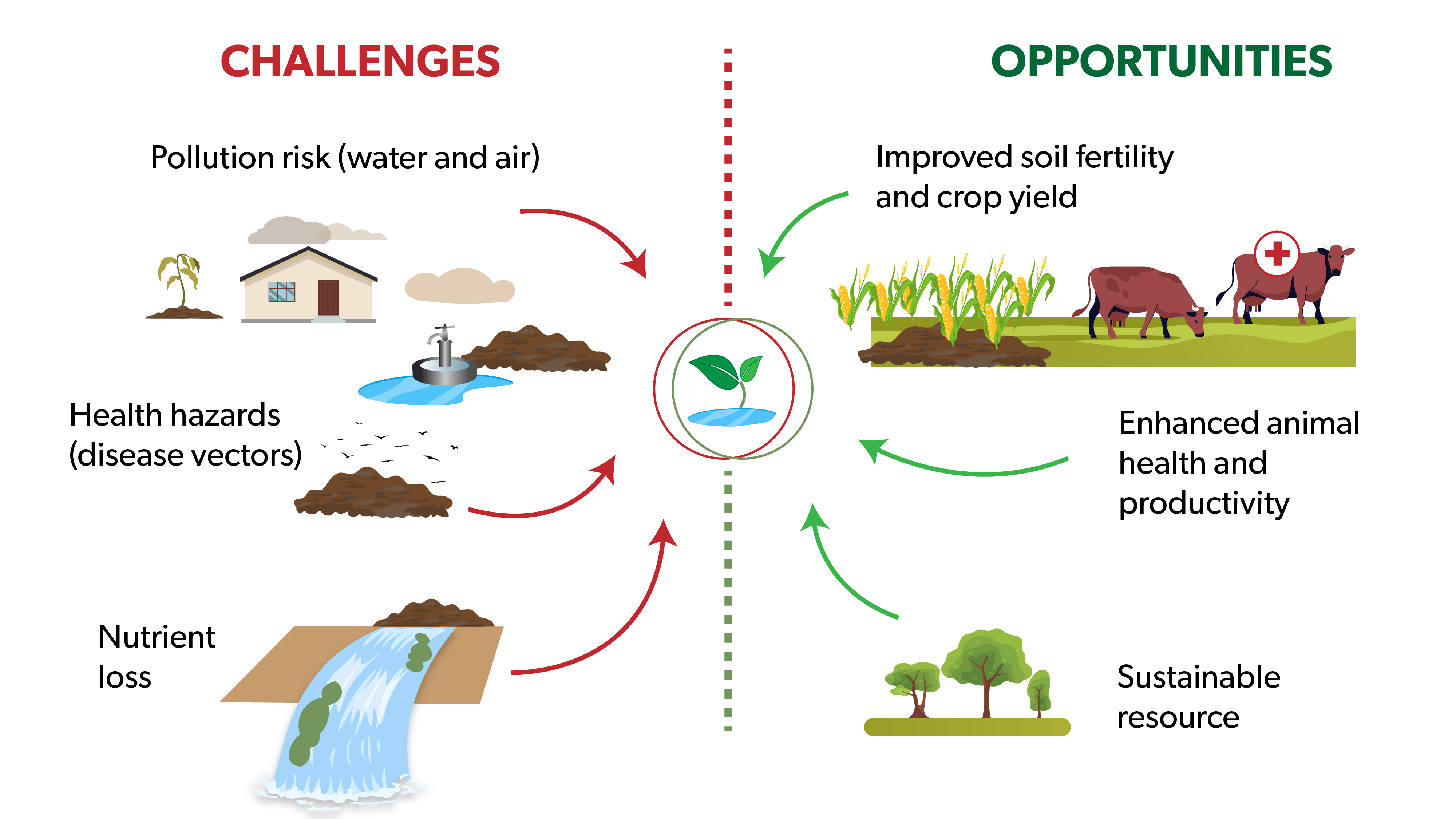
In Sub-Saharan Africa, smallholder farms are often faced with nutrient limitation due to costs for synthetic fertilizers, leading to reduced crop productivity and income (FAO, 2025). Livestock manure is an important locally available resource for enhancing crop productivity and generation of bioenergy, when managed and utilized properly and efficiently. In Uganda, manure production has increased with an increase in livestock population. Between 2008 and 2021, the livestock populations increased from 11 to 14 million cattle (+27%), from 12 to 17 million goats (+39%), and from 3 to 7 million pigs (+123%) (UBOS, 2021). If poorly managed, manure can be a source of GHG and ammonia emissions, as well as nutrient leaching, resulting in air and water pollution (Wanyama and Leitner, 2019). Conventional manure management practices are associated with delayed and irregular collection patterns and handling practices by the farmers that expose manure to direct sunlight and are prone to nutrient runoff following rainfall events. In addition, the common practice of spreading untreated manure on the soil presents a high risk of pathogen distribution into the environment. When mismanaged, manure can present substantial health risks to animals and humans, including infection of livestock, crops, and people by parasites/microorganisms, protozoa, and viruses (Bej et al., 2023). Thus, the consequences of suboptimal manure management are multiple, and solutions need to be assessed holistically, also considering local contexts.
Opportunities for and through improved manure management
Improved manure management provides an opportunity for farmers to increase farm productivity and to safeguard the environment as well as the health of humans, crops, and animals. At the national level, better manure management is an opportunity for Uganda to improve food security and nutrition, and on-farm health, while reducing input dependency and environmental pollution. Local examples focusing on cattle manure showed that improved manure management practices increased maize crop productivity between 10-18%, compared with conventional management (Zake et al., 2010). Such improved manure management practices involve daily collection of livestock excreta, reduced exposure to direct sunlight and rain through roofing or covering, and composting to improve manure fertilizer value and ensure its sanitization. In addition, improved manure management practices have additional benefits such as climate mitigation and adaptation as well as subsequent improved livelihoods.
Policies for improved manure management
Uganda has a policy, legal and institutional framework to guide and regulate manure management for sustainable utilization, to accrue maximum benefits and to safeguard against environmental and health risks to animals and humans. Some of the policies and laws that provide the guiding framework for manure management in Uganda include Uganda's National Climate Change Policy 2015, National Organic Agriculture Policy 2019, National Fertilizer Policy for Uganda 2016, National Climate Change Policy 2015, National Soils Policy (Draft since 1992), Environment Act 2019, Uganda Climate Change Act 2021, and the Occupational Health and Safety Act 2006.
Policy analysis
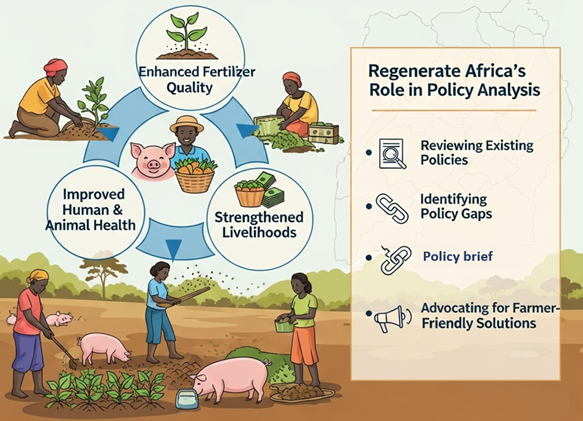
In this context, Regenerate Africa, with support from ILRI is currently leading a policy review and gap analysis of manure management and associated environmental and risk management in Uganda. This is implemented under the CIRcularity of Nutrients in Agroecosystems and co-benefits on animal and human health (CIRNA) Project. The project aims at advancing the development, assessment, and promotion of farmer-approved, field-tested manure management practices for smallholder mixed crop-pig systems in Uganda that ensure better organic fertilizer quality, health and safety for humans, animals, and the environment, and improved livelihoods.
Objectives:
a) Identify the key policy and practice issues linked to manure management in smallholder pig production systems and associated environmental and health risks management in Uganda.
b) Propose responsive and targeted recommendations for advancing sustainable manure management practices, and associated environmental and health risks management practices at national, landscape (agro-ecological zones), community, and farm/household level.
Expected outcomes:
- Better understanding and appreciation of the policy gaps, emerging issues, and responsive recommendations for advancing sustainable manure management practices, and associated environmental and health risks.
- Development of a draft policy brief, which will be validated through a multi-stakeholder dialogue involving key policy and decision makers, to generate the final published document.
- Increased awareness among policymakers about the importance of manure, the benefits of sustainable manure management, and associated environmental and health risk management.
First insights into existing policies and interventions
Our preliminary results raise questions about whether the existing policy, legal, and institutional framework in Uganda is adequate and robust enough for sustainable management and to protect against environmental and health risks.
Here is what we found:
a) Increased quantities of manure generated without proper management, utilization, and disposal lead to a magnification of the unanticipated environmental, human, and health risks
b) Climate change and variability impacts are further magnifying the negative consequences of inadequate manure management. Simultaneously, Climate-Smart Agriculture Guidelines exist and recommend reduced storage time, aeration, stacking (stockpiling), and biogas production (MAAIF, 2018). However, to date, these guidelines are very general and do not stipulate which practices are suitable for the different livestock systems. Furthermore, the feasibility of these practices and their linkages to animal and human health are not clearly defined.
c) Difficulties arise when aiming at harmonizing manure management strategies since responsibilities regarding manure management are shared across multiple ministries. In consequence, incoherence in the implementation of responsibilities and strategies is a reality. At the same time, a key policy that would provide guidance on sustainable manure management, namely the Ugandan National Soils Policy, has remained in a draft stage for over 20 years, since 1992.
d) Furthermore, while several existing policies recommend the use of organic fertilizers (which includes animal manure), there are no recommendations on optimal manure use and application.
f) Policy and legal frameworks for manure management need to be inclusive and have to be mainstreamed for gender and youth to address the concerns and needs of different groups with respect to manure utilization and management. This is based on considerations that different gender categories (women, men, and youth – boys & girls) have different interests, roles, and responsibilities in the manure management chain. These are largely influenced by the following:
- Social and cultural construction. For instance, men are more likely to be involved in manure collection, because the process is labour-intensive. Women are involved in manure management and application because of their role in vegetable production at the household level.
- Interest in a specific crop value chain, by a specific gender category. Some crop value chains require the application of manure in substantial amounts to ensure effective productivity. For instance, youth who are interested in tomato and passion fruit production often get involved in manure management and application, because both value chains require the application of manure and fertilizers for a good harvest.
- The value attached to the manure, especially the monetary value. Men would be more interested and involved in manure management when the monetary value attached to manure is high, for example, when manure is in high demand and prices are high.

The key policy and decision makers at the national and local levels in Uganda are called for their active participation in the ongoing policy review and gap analysis process by giving their views and opinions through our online platform.
You can sign up for access to the final policy brief after completion and overall project news through https://www.linkedin.com/groups/10052047/
Supporting information: Methodology of the policy review and gap analysis
The policy review and gap analyses is implemented through the following four activities:
Policy review focusing on a review of relevant policies for sustainable manure management and associated health risks management, using a policy review guide with specific questions on the following aspects/themes:
- Level of consciousness of the policy/legal/program document in respect to articulation of manure management in its problem analyses, objective, statement, and strategy levels respectively;
- Whether the policy/legal/program document stipulates commitments on sustainable manure management, and associated environmental and health risks management. These include: strategies, actions, and budget allocations;
- Extent of social inclusion of women and youth in the policy/legal/program
Gap analysis guided by identification of policy commitments, statements on and associated strategies for sustainable manure management. It involves comparison of the desired situation (e.g., clear commitments and responsibilities given, budget allocated, gender aspects included) with the current situation for each policy document, with clear analyses of the underlying gaps and limitations towards achievement of the key targets. Thus, the gap analysis will consider each relevant policy by reflecting on the extent to which the desired changes (i.e., in manure management, and associated management of the environment and as stipulated in that policy document) have been implemented. This reflection is not subjective, but rather objective and based on facts, depicted in progress performance/evaluation reports about policy implementation in this respect. The assumption is that the policy document describes the desired changes (situation/levels in terms of policy commitments, targets, and budget commitments). However, this can vary on a case-by-case basis for each policy. Specific focus will be on policies that have a clear description of the desired situation. The underlying policy and institutional structure gaps, and emerging issues (i.e., challenges and opportunities) which limit effective implementation of strategies and delivery of desired policy outcomes, will be identified.
Engagement with policy makers, involving their active participation at national and local levels as key informants. The aim is to capture their perceptions and opinions regarding sustainable manure management and associated health and environmental risks management. The key informants will include technical staff of the key ministries (Min. of Water and Environment, Min. of Health, Min. of Agriculture, Animal Industries & Fisheries, Min. of Gender, Labour and Social Development, Min. of Energy and Mineral Development), local governments of districts where the CIRNA project is implementing activities in Uganda (Mpigi, Buikwe and Mukono), civil society organizations (CSOs), academia and research institutions. Additional key informants will be identified through the individuals interacted with. In total, a minimum of 30 policy and decision makers at national and local levels in Uganda are foreseen to provide inputs. These will be purposefully selected based on their mandates, roles, and responsibilities as stipulated in the existing policy, legal, and institutional framework on sustainable manure management. The key informants will be engaged through both online and in-person interviews. The in-person interviews will target the frontline key policy makers with the mandates and role for policy formulation and implementation, i.e., members of the key Ministries and Local Government. Thus, individual interviews and Focus Group Discussions will be conducted for national and local-level policy makers, respectively. The CSOs, Academia, and Research Institutions, operating at the national level, will be engaged through online platforms.
The key informant interviews with the selected policy makers will be guided by a key informant checklist, which will stipulate specific questions on the following themes:
- Policy interventions for addressing sustainable manure management;
- Performance in implementation of the policy interventions for addressing sustainable manure management;
- Institutional arrangements for implementation of policy interventions for advancing sustainable manure management in Uganda;
- Key emerging issues (challenges and opportunities) for addressing sustainable manure management;
- Key lessons learnt from the implementation of policy interventions for addressing sustainable manure management;
- Gender and manure management;
- Recommendations for advancing sustainable manure management and associated safeguards for health and environmental risks in Uganda.
Manure management survey: In addition to the policy review, manure management surveys are currently conducted by ILRI and Makerere University for capturing additional information on policy issues at the farm level in Buikwe, Mpigi, and Mukono districts. This involves 600 household interviews, targeting male and female household heads and others who take care of manure management. The surveys are conducted between June and December 2025, and the overall objective is to capture existing manure management practices by farmers at the household and farm levels, and their socioeconomic and agroecological context.
Disclaimer
The Swiss Federal Excellence Centre for Agricultural Research (Agroscope), in collaboration with the International Livestock Research Institute (ILRI) in Kenya and Uganda, and the NGOs Regenerate Africa, Women Farmers’ Association of Kenya, and Vétérinaires Sans Frontières Germany (VSFG) are implementing the project ‘CIRcularity of Nutrients in AgroecoSystems and co-benefits on animal and human health (CIRNA) Project’ (SNSF, 2023). The project is funded by the Solution-oriented Research for Development (SOR4D) programme, a joint funding instrument between the Swiss Agency for Development and Cooperation (SDC) and the Swiss National Science Foundation (SNSF).
Related Publications
Collective governance and household-Level decision-making in Afar pastoral systems: Implications for Pioneer Positive Deviance